
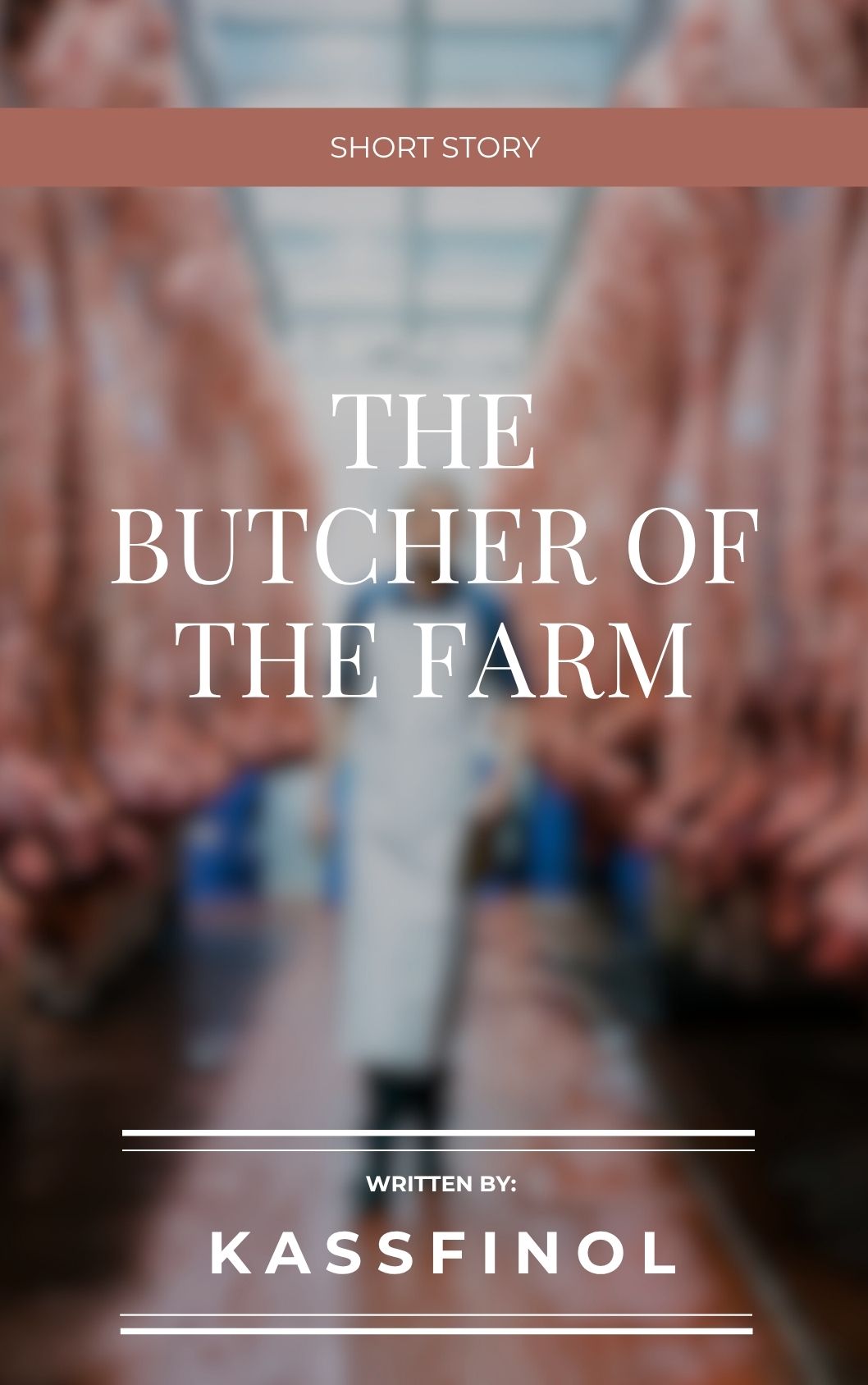
Title: The Butcher of the Farm
Author: Kassfinol
All rights reserved
Genre: Psychological horror – Post-apocalyptic – Moral horror
The blood on the apron doesn’t bother me anymore. Three years since everything went to hell and my hands stopped shaking a long time ago. Work is work; it always was. Before, in the town butcher shop, now here. Meat is meat.
“Dad, there’s someone at the fence” —Clara shouts from the second-floor window.
I put the knife down on the work table and wipe my hands on the rag. Another one. That’s four this month. The harvest has been good.
“How many?” —I ask, going up the stairs.
“Just one. He looks young.”
I look out the window. A skinny guy, twentysomething maybe, leans against the wooden fence. He carries a tattered backpack and limps on his right leg. Perfect. The lame ones don’t run.
“Is he bitten?” —Clara squints.
“You can’t see the fever on him yet. But give it a few hours.”
My daughter doesn’t answer. She’s sixteen and still struggles to understand that compassion is a luxury we can’t afford. Her younger brother, Tomás, understands it better. Or maybe he just stopped asking.
I go down and open the front door. The guy lifts his head as I approach. His eyes are sunken, his skin grayish. Severe dehydration.
“Please” —his voice is a croak—. “I just need water. And a place to… to rest for a night.”
“Are you alone?”
He nods. A lie, probably. They always lie at first.
“Bitten?”
“No. I just… twisted my ankle. Three days ago. I haven’t eaten since then.”
I give him a full look. No visible weapons. His ribs show under his dirty T-shirt. This one won’t cause trouble.
“All right. You can come in. But there are rules.”
His eyes light up with something I’d almost forgotten: hope. Poor idiot.
I lead him inside. Clara is in the kitchen, stirring the dinner stew. Pork, potatoes, carrots. The pigs are fat this year. Well fed.
“He’s…” —I realize I didn’t ask his name.
“Mateo” —says the guy, practically dragging himself to a chair—. “God, thank you. Thank you so much. I thought… I thought I wasn’t going to find anything.”
Clara serves him a glass of water. He drinks it as if it were the last thing he’s going to drink. Technically, he’s not wrong.
“Slowly” —I warn him—. “Or you’ll throw it all up.”
Mateo nods, slowing down. His eyes wander around the kitchen, the full cupboards, the strings of onions hanging from the ceiling, the fresh bread on the table. This place is a fucking anomaly in the middle of hell, and he knows it.
“How do you do it?” —he asks—. “How do you keep all this… working?”
“Hard work. Planning.” —I sit across from him—. “And sacrifice.”
He doesn’t catch the double meaning. They never do.
Clara serves him a plate of stew. Mateo devours it without asking what kind of meat it is. Better that way. Questions are uncomfortable.
“You can sleep in the barn tonight” —I tell him—. “Tomorrow we’ll see what we do about that ankle.”
“I don’t know how to thank you.”
“No need.”
That night, when the kids are asleep, my wife Carmen finds me on the porch. She’s smoking one of the last cigarettes we have left. Her face is a mask of permanent exhaustion.
“He’s very young” —she says without looking at me.
“Age doesn’t matter.”
“Clara was looking at him during dinner.”
That stops me. I look toward my daughter’s window. The light is off.
“She’s old enough to understand how things are.”
“Is she?” —Carmen exhales the smoke—. “Because I’m forty-two and I’m still not sure I understand it.”
“Then stop thinking. Thinking is what kills people now.”
She laughs, but it’s a bitter sound.
“No, honey. We’re what kills people now.”
I don’t answer. There’s nothing to say. Carmen puts out the cigarette and goes inside. I stay on the porch, listening to the sounds of the farm: the pigs grunting in their pen, the hens restless in the coop, and from the barn, the heavy breathing of someone who thinks he’s safe.
The next day, Clara disappears after breakfast. I find her in the barn, sitting on the straw next to Mateo. They’re talking in low voices, almost whispering. He shows her something, a photo, wrinkled and faded.
“She was my sister” —Mateo says—. “A group of looters took her. A year ago. I escaped, but she…”
Clara touches his shoulder. A simple gesture, but it stabs something in my chest.
“We have to check that ankle” —I interrupt. My voice sounds harsher than I intended.
Clara jumps, as if I’d caught her stealing.
“We were just talking, Dad.”
“Go help your mother.”
She looks at me with those eyes she inherited from Carmen, full of silent defiance. But she obeys. She always obeys.
When she leaves, I approach Mateo. He tries to stand up, but I gesture for him to stay seated.
“Let me see that leg.”
I kneel down and examine his ankle. It’s swollen, bruised. A severe sprain, maybe a minor fracture. It’ll heal in a few weeks with proper care.
Too bad he doesn’t have a few weeks.
“Can I stay a little longer?” —he asks—. “Just until I can walk properly. I can work. I know about crops, about animals. I can be useful.”
Useful. The word makes me smile.
“You already are useful, son.”
He doesn’t understand what I mean. You can see it on his face, that stupid expression of gratitude.
How easy it is to fool people when they’re desperate.
The next three days are a problem. Clara spends every free minute with Mateo. She brings him extra food, clean bandages for his ankle, books from our collection. I watch from the window how they laugh together, how he touches her arm when he talks.
Carmen notices it too.
“You have to do it soon” —she says one night in bed—. “Before she gets more attached.”
“It’s already too late for that.”
“Then make sure she’s not there. Send her to town with Tomás. Make up an excuse.”
It’s a good plan. But something holds me back. Maybe it’s the way Clara smiles now, something I hadn’t seen in months. Or maybe it’s the fact that Mateo reminded her there’s a world beyond this farm, beyond the decisions I’ve had to make.
On the fourth day, I find Clara crying in her room.
“What happened?”
“Nothing” —she wipes her eyes quickly—. “It’s just that… Mateo told me about how it was before. About his family. About the plans they had.”
I sit on her bed.
“That doesn’t exist anymore, Clara.”
“I know. But… what if it could exist again? What if we could…?” —she looks at me with shining eyes—. “What if he stayed? He could help us. He could be part of the family.”
There it is. The question I knew would come.
“We can’t feed another mouth.”
“But he can work. He said he knows about crops, that…”
“Clara.” —My voice is firm—. “The answer is no.”
She doesn’t argue, but I see the betrayal on her face. She leaves the room slamming the door. Carmen appears in the hallway.
“She knows something” —she says in a low voice—. “Maybe not everything, but something.”
“It’s impossible.”
“Kids aren’t stupid. They’ve seen things. They’ve heard things.”
That night, I can’t sleep. I go down to the kitchen and pour myself a drink of the whiskey I keep for emergencies. An emergency. That’s what I have now.
I hear footsteps on the stairs. Clara. She stops when she sees me.
“You can’t sleep either” —she says.
“Come. Sit down.”
She hesitates, but finally comes over and takes a seat across from me.
“What happened to the others?” —she suddenly asks.
My hand freezes with the glass halfway to my lips.
“Which others?”
“The ones who came before. Like the woman last month. And the man with his son. The ones who stayed a few days and then… disappeared.”
I lower the glass slowly.
“They left. They went on their way.”
“Without saying goodbye.” —It’s not a question—. “And the pigs always get fatter after they leave.”
The silence stretches between us like an abyss. I can see her mind working, connecting dots I tried to keep separate.
“Clara…”
“I don’t want Mateo to disappear.”
I look her in the eyes. Those eyes that know the truth but refuse to admit it.
“Sometimes we have to do terrible things to survive” —I say finally—. “Things we never imagined we’d be capable of doing.”
“Like what?” —Her voice trembles.
“Like choosing between a stranger and your family. Between what’s right and what’s necessary.”
Tears run down her cheeks.
“There’s another way. There has to be.”
“There isn’t.”
“Then we’re monsters.”
The word hangs in the air. Monsters. Maybe she’s right. But monsters survive when humans die.
“Go to sleep” —I tell her—. “Tomorrow will be a long day.”
She gets up, but before leaving, she stops at the door.
“If you do it” —she says without looking at me—, “I’ll never forgive you.”
“I know.”
The next morning, I prepare things. The sharp knife, the chains, the tarp. Everything I need is in the shed behind the barn. I’ve done this enough times to know exactly how long it takes, how much noise it makes, how to minimize the mess.
But when I go to the barn, Mateo isn’t there.
I find Clara in the kitchen. She’s preparing breakfast as if nothing happened. But her eyes are red.
“Where is he?”
“He left” —she says without emotion—. “At dawn. I gave him supplies. And a map.”
The rage rises in my throat like bile.
“What the fuck did you do?”
“What I had to do!”
I grab her arm, hard.
“That was our supply! Those supplies you gave him were for us!”
“He was a person!” —she shouts, freeing herself—. “A fucking person, Dad!”
Carmen comes running. Tomás is behind her, pale.
“What’s going on?”
“Your daughter just doomed this family.”
“I saved someone” —Clara faces me—. “Someone had to do it.”
I slap her. It’s not hard, but the sound echoes in the kitchen like a gunshot. Carmen gasps. Tomás steps back. And Clara looks at me with something worse than hate: disappointment.
“Go to your room” —I say with a trembling voice.
She goes up the stairs without saying anything else.
Carmen comes closer to me.
“You need to calm down.”
“I need my kids to understand we’re not playing. That every stupid decision…”
“She already understands” —Carmen interrupts—. “She understands more than you imagine. And that’s why she let him go.”
I don’t answer. I go out to the porch and stay there, looking at the gate where Mateo appeared five days ago. The gate through which he now left, taking supplies we need and leaving behind a crack in this family I don’t know how to repair.
The pigs are hungry. I can hear them from here, grunting, waiting. They’re going to have to wait longer.
That night, Clara doesn’t come down for dinner. Carmen takes her a plate, but comes back with it untouched.
“Give her time” —she says.
Time. As if we had that luxury.
Two weeks later, another traveler arrives. A woman, older, with an infected wound on her arm. She won’t last long anyway. When I open the fence, Clara sees me from her window. Our eyes meet for a second.
Then she closes the curtains.
And I lead the woman to the barn, the knife already sharpened, the chains already prepared, telling myself this is survival. That this is love. That a father does what he has to do.
But my daughter’s face, that mix of horror and understanding, haunts me while I work. It haunts me while I feed the pigs. It haunts me when I wash my hands and the blood disappears down the drain, but the stain remains.
The pigs are fat again.
And my daughter no longer looks me in the eyes.
I suppose that’s how things are now. We survive. We move forward and do what’s necessary.
But there are nights when I wake up and wonder if what I kept alive was really my family, or just the bodies that were once my family. If the difference matters when the world is already dead.
Work is work.
Meat is meat.
And monsters, as I see it, don’t need fangs.
They just need good enough reasons to act.
The End