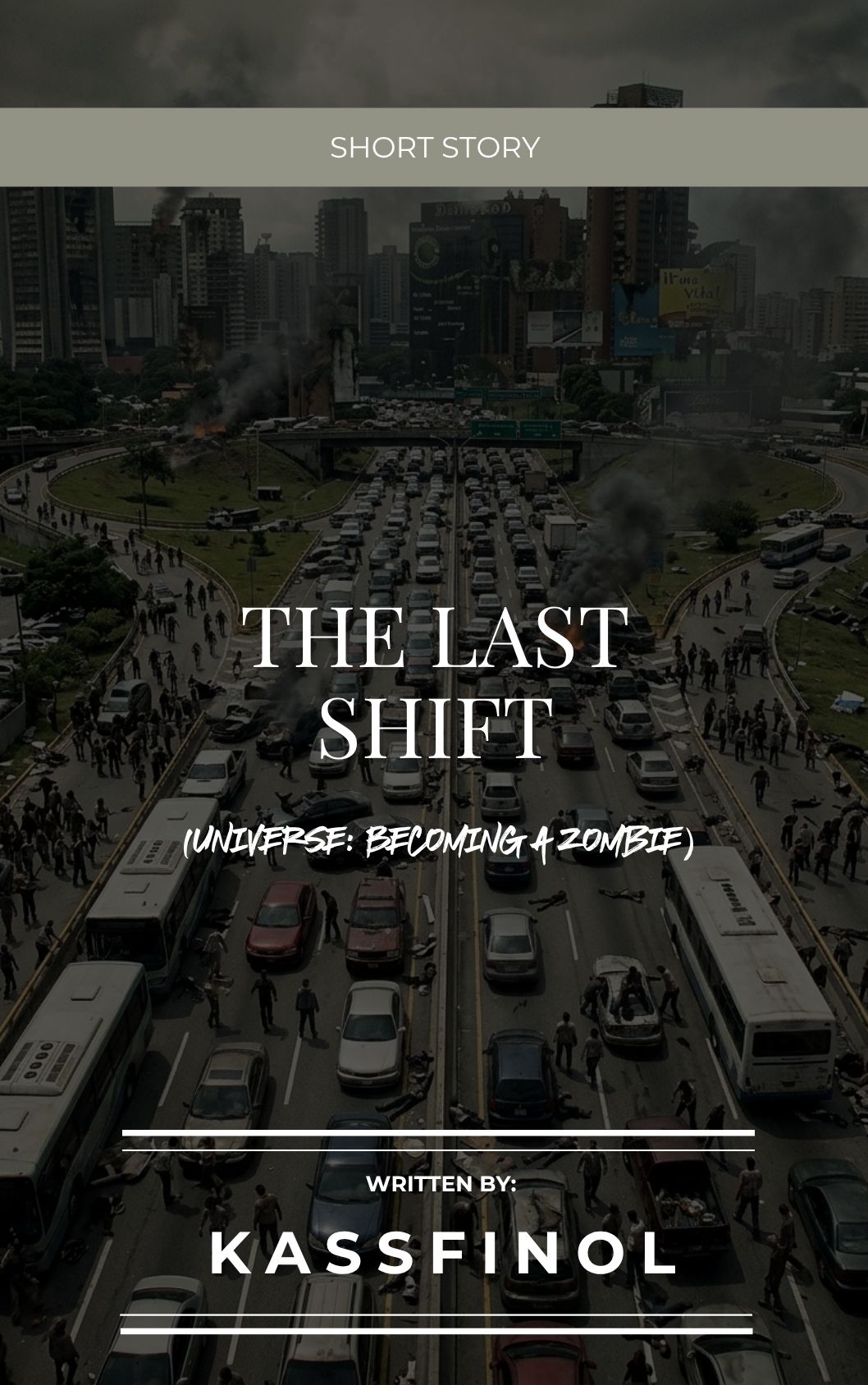
Title: The Last Shift
Author: Kassfinol
Universe: Series: Becoming a Zombie
Genre: Post-apocalyptic fiction / Zombie horror
All rights reserved.
An immovable mass of steel and glass blocked the Francisco Fajardo highway from the Altamira interchange, choking off any attempt to advance under the relentless afternoon sun. Manuel let go of the steering wheel of the paramedic unit to lean his back against the seat of a cab where the air conditioning had been broken for forty minutes, letting a thick thread of sweat run down the back of his neck and soak the collar of his shirt while Raúl, beside him, flipped through the pages of the logbook, tracing lines of ink that the humidity blurred.
The digital clock on the dashboard blinked as it changed to five fourteen, a second before a horn tore through the air of the fast lane with a sharp buzz. Manuel turned his head just as a gray sedan rear-ended a cargo truck, unleashing a metallic crunch that bounced off the retaining walls. Although the impact shattered the headlights of the smaller vehicle, the driver didn’t get out to check the damage; his body had slumped over the steering wheel, his face pressed against the center of the plastic, keeping the horn pressed all the way down.
Manuel unbuckled his seat belt and opened the door, taking a wave of thick heat in the face that smelled of rubber and burnt diesel. Two rows ahead, the door of a taxi flew open to let a woman crawl out and fall to her knees on the white line of the pavement, both hands clutching her throat while her jaw clenched until the tendons stood out under her skin. With her eyes wide toward the cloudy sky, a spasm crossed her spine, bending her body backward in an unnatural arc before she collapsed face-first onto the hot concrete.
Raúl got out through the passenger door with the red first-aid kit hanging from his shoulder.
“Seizure?” Raúl asked, jogging between the stopped cars.
Manuel followed behind him without answering, watching how, at the far end of the traffic jam, four doors opened in sequence to drop four bodies onto the road under the same pattern of muscle tension and silence. There were no screams, no attempts to break the fall; only the dull thud of flesh against asphalt, accompanied by the muffled buzz of the horn in the wrecked sedan.
Raúl dropped the first-aid kit and knelt beside the woman while Manuel quickened his pace to make his way between the jammed bumpers.
“No pulse,” Raúl said, pressing two fingers against her carotid before taking a small flashlight from his vest to lift her right eyelid.
The woman didn’t react, her pupil dilated and fixed against the beam of light. At the same time, the buzzing of the horn stopped when the driver of the gray sedan lifted his head, revealing a circular red-stained impact on the windshield, before shoving the dented door open with his shoulder to get out onto the road, dragging his left leg.
Manuel looked ahead when he heard a liquid gurgle at the instant the woman lying under Raúl’s hands took a gulp of air, inflating her lungs with the sound of a tube clogged with blood. Raúl recoiled, bracing his palms on the ground to stand up, but the woman turned her neck toward him with no transition between stillness and attack; she launched herself from the pavement to sink her teeth into the paramedic’s forearm, tearing the uniform fabric in a single pull. Raúl let out a muffled cry, trying to pull back while the skin of his arm gave way.
Manuel ran toward them while around him the other four fallen bodies began to rise in silence, ignoring the vehicles and the heat of the asphalt to advance straight toward the cars with their windows down. He grabbed Raúl by the straps of the tactical vest and pulled with all his weight, forcing the woman to let go so she could chew the piece of cloth and flesh before getting to her feet with her jaw hanging, skewed to the left.
“To the unit,” Manuel said.
Raúl stumbled backward, clutching the wound with his uninjured hand to stop the dark blood running down his fingers, while Manuel pulled the heavy aluminum flashlight from his belt to place himself between his partner and the woman. She advanced with her arms hanging and her mouth open, taking the full swing of the flashlight; the metal cylinder struck her left temple with a dry crack, breaking the bone under the weight of the aluminum and making her lose her balance until she fell sideways against the bumper of a taxi without trying to protect her face.
Ten meters away, the driver of the gray sedan smashed the window of a family van with his fists, shattering the glass to smother the scream from inside under his weight as he climbed in through the window while the sound of engines revving in neutral invaded the highway. Car doors flew open, letting out passengers who ran toward the retaining wall, only to be intercepted by the reanimated bodies before they reached the concrete.
“Walk,” Manuel ordered, pushing Raúl in the back.
Raúl tripped between the jammed bumpers, leaving a trail of drops on the dividing line between the lanes. He advanced until Manuel pulled the passenger-door handle, pushed him into the seat, and closed the door. As he went around the hood of the ambulance, a man in a suit jumped on him from the roof of a neighboring car. Manuel raised his left arm to block the impact. After feeling the teeth slide over the thick canvas of the uniform, he drove the base of the flashlight into the attacker’s throat, shoved him against the asphalt, and opened the driver’s door.
He jumped in and lowered the electric locks while outside the man in the suit slammed against the window glass, leaving a smear of saliva and blood on the glass, then turning his head toward a motorcyclist trying to start his machine between two guardrails. In the next seat, Raúl breathed in short gasps and pressed the wound with his good hand, letting the blood soak the fabric of his pants and pool on the rubber mat of the cab until Manuel reached into the overhead compartment for a tactical tourniquet.
“Take your hand off,” Manuel said, sliding the nylon strap above Raúl’s elbow to twist the plastic rod.
Raúl gritted his teeth as he felt the flow of blood slow to a lazy drip inside a cab where the temperature kept rising from the trapped heat. Half-isolated from the screams and the crunch of glass on the highway, Raúl rested his head against the window, his skin covered in cold sweat and his pupils dilated to the limit.
“My chest hurts,” Raúl said.
Manuel tightened the tourniquet’s Velcro with a sharp tug that stopped the bleeding completely, letting his partner slump against the backrest with his eyes closed while his breath fogged the door glass.
“Your pressure is going to spike from the trauma,” Manuel said, securing the plastic rod in the retention clip. “Keep your arm raised.”
Raúl nodded slowly, showing the edges torn by teeth in the forearm wound; the bleeding was under control and his pulse stayed strong, but the clinical picture made no sense against the logic of a system where the woman from the taxi had fallen dead on the road without shedding a drop of blood, only to reanimate in seconds. Manuel ran through the trauma manuals in his head, confirming that nothing fit with what was happening on the other side of the windows.
Outside, the highway had stopped being a traffic jam and become a linear slaughterhouse, where a man in a plaid shirt ran across the roofs of the jammed cars, fleeing until a woman grabbed him by the ankle to drag him into the narrow space between two vans and smother his screams.
“We have to get out of here,” Manuel said.
“The interchange…” Raúl murmured, opening his heavy eyes. “The ramp to the Civil Protection base is three hundred meters away.”
Manuel looked through the cracked windshield at the lanes blocked by a mass of sheet metal and broken glass, assessing the emergency shoulder, which offered a clear strip barely two meters wide against the concrete wall. With no room to hesitate, he put it in first gear, making the diesel engine roar, stepped on the accelerator, and turned the wheel to the right, forcing the front bumper to hit the headlight of a taxi, shoving it aside with a screech of bent metal until he managed to get the tire up onto the shoulder.
He advanced at thirty kilometers an hour without turning on the siren. He scraped the paint on the left side against the unbroken row of parked cars and rasped the right rearview mirror against the concrete wall. Three reanimated bodies came out from between the cars to block the emergency lane, stopping face-first toward the radiator without raising their hands. Manuel pressed his foot down on the accelerator. The ambulance hit them head-on. The first bounced off the hood and crashed into the windshield, leaving a spiderweb of cracks across the glass before falling to the asphalt. The other two were run over under the chassis with two dull thuds in the suspension.
Raúl clung to the ceiling handle with his uninjured hand, breathing shallowly.
“It burns,” Raúl said, looking at the wound hidden under the tactical tourniquet. “I feel like you poured acid on my arm.”
“It’s the compression,” Manuel replied, keeping his eyes on the exit of the Altamira interchange to avoid looking at the cold sweat soaking his partner’s face or the unnatural tremor beginning to shake his legs.
They managed to crest the ramp and leave the Francisco Fajardo highway to enter an urban scene where the collapse of the drivers had turned the main avenue into a field of collisions dominated by dozens of private cars smashed against trees and the barriers of residential buildings, under the first columns of black smoke rising in the distance over the rooftops. Manuel drove the ambulance to the entrance of the Civil Protection operations base, crossing a chain-link mesh gate that stood open with an empty police patrol car wedged in the middle, with no trace of guards in the sentry box and no movement in the yard. When he braked the unit ten meters from the gate and turned off the engine, silence fell over the cab, broken by Raúl’s labored breathing and the distant buzz of the fire alarms, prompting Manuel to grab his aluminum flashlight and sling the spare first-aid kit over his shoulder before unlocking the doors.
“We get out here,” Manuel said. “Lean on me.”
Raúl opened the passenger door to lower his legs, but when his knees gave way against the asphalt, Manuel had to hold him by the belt of the vest and pass his partner’s good arm over his own shoulders, adjusting his posture to bear a dead weight that threatened to pull them both down. As they walked toward the pedestrian entrance of the base, Manuel felt the dense, feverish heat radiating from Raúl’s body through the thick fabric of the uniform, spreading outward and growing with every step.
They crossed the chain-link gate into the empty front yard, dotted with dirty gauze and abandoned communication radios on the cement, advancing to the glass doors of the reception area, which showed signs of having been forced from inside. After pushing the broken glass aside with his boot, Manuel dragged Raúl into the waiting room, dodging the overturned plastic chairs, to lay him on a rigid rescue stretcher blocking the hallway to the locker rooms; his partner kept his eyes closed, his breath whistling in his throat and sweat soaking the collar of his shirt.
“I’m going to look for the IV kit and saline,” Manuel said.
Instead of answering, Raúl clenched his good hand on the plastic edge of the stretcher so hard that his knuckles turned white and cracked under the pressure.
Manuel ran to the on-duty pharmacy, finding the security grate open and the medicine boxes thrown on the floor under looted shelves, managing to rescue two intact IV bags and a catheter under an overturned counter. Just as he picked up the supplies, he heard a dull thud from the hallway followed by the screech of plastic dragging across the tiles, forcing him to leave the pharmacy with the catheter in his hand to discover the rigid stretcher empty, its restraint straps hanging toward the floor.
“Raúl?” Manuel called.
The sound of shuffling footsteps came from the darkness of the locker rooms at the end of the hallway. Manuel switched on the flashlight and let the beam cut through the gloom to stop on a dark puddle staining the entrance to the showers, forcing him to walk close to the wall, gripping the aluminum cylinder while the dull beat throbbed in his temples; a fever couldn’t kill a healthy man in three minutes without causing visible shock or prior convulsions, confirming that the medical rules were crumbling around him.
As he pushed open the locker room door, he was hit by a smell of iron and stagnant urine, discovering Raúl from behind, kneeling in front of the row of lockers; but instead of holding his wounded arm, his hands were tearing pieces of flesh from the neck of a paramedic from the morning shift who lay motionless on the tiles. With his pulse racing, Manuel raised the flashlight to light his partner’s neck, and Raúl stopped tearing tissue to turn his torso on his knees and look toward the door with unfocused eyes, his sclera covered by a web of broken capillaries and a piece of muscle falling from his chin.
The weight of the aluminum cylinder slipped in Manuel’s sweaty palm as he stepped back onto the sticky puddle at the entrance, watching how Raúl skipped any attempt to stand with support and launched himself from the floor in a rigid spasm, hurling himself toward the hallway with his jaw open. Manuel raised the flashlight and landed a crosswise blow that smashed the metal cylinder against his partner’s jaw, breaking the bone with a wet crunch. Raúl was thrown backward against the locker wall and slid to the floor. The creature made no attempt to raise its hands to its face and made no sound before getting up again.
Without waiting for the second attack, Manuel retreated toward the main hallway, pulled the locker room door shut, and slid the security bar through the metal rings with trembling hands just as the blows from inside began to dent the aluminum with a forceful rhythm. He dropped the IV bags to the floor. Medicine and compression were spent resources against bodies that ignored clinical death. He retreated toward the reception, looking for the exit with ragged breathing. Outside, the noise of heavy engines and the screech of tires on asphalt drowned out the buzz of the alarms. Three military transport trucks braked in front of the base’s gate.
Manuel crawled below the line of the reception windows to peer between the remains of broken glass, watching how the rear tarps of the trucks lifted in unison to drop two dozen soldiers onto the asphalt; they descended in absolute silence, without shouting orders or turning on megaphones to group the survivors, wearing gas masks fitted to their faces and assault rifles held to their chests.
A woman came stumbling from behind a crashed patrol car and raised her arms toward the uniformed men, half her blouse covered in blood, walking on her own feet while crying incomprehensible words. The soldier in the vanguard ignored any medical protocol and raised the rifle barrel to fire twice, lighting the darkened street with the flashes of the weapon before the woman fell to her knees and collapsed onto the pavement.
The sound of the shots reverberated in Manuel’s chest, leaving a sharp ringing in his ears in the face of the evidence of a squad that ignored the sanitary cordons dictated by the manuals to advance in a perfect line of extermination, executing the reanimated bodies crawling through the street with the same mechanical cadence they applied to finishing off the wounded who begged for help. They brought no ambulances or support stretchers, limiting their advance to a burst of lead and heavy boots crushing the empty shell casings.
When four soldiers separated from the main formation to turn toward the entrance of the paramedic base, their tactical flashlights swept the front yard, crossing their beams over the abandoned ambulance, which forced Manuel to leave his aluminum flashlight on the floor to avoid any betraying reflection and retreat on all fours down the main hallway.
Taking advantage of the fact that Raúl’s blows against the locker room door kept echoing down the corridor to mark the exact position of the internal threats, Manuel turned toward the maintenance room, looking for the back alley through a service door while behind him the military boots crunched the reception glass. As he turned the handle with both hands to silence the mechanism, the inevitable metallic squeak was buried by a rifle burst that shattered the aluminum sheet of the locker rooms, clearing the way for Raúl’s reanimated body to throw itself at the uniformed men, ignoring the bullets hitting his torso.
Under the cover of the crossfire, Manuel pushed the back door open and stepped into the narrow alley where the night air stank of burnt garbage and gunpowder; he dropped the Civil Protection radio on the cement, ready to lose himself among the columns of an adjacent residential parking lot, but a muffled whimper stopped him cold. Beside the garbage containers, a teenager in a torn shirt pressed both hands against a wound on his thigh and looked up, letting out a dry sob just before a shadow detached itself from the fire escape of the neighboring building, dropping a reanimated man onto the pavement who bent his knees, absorbing the impact without suffering structural damage.
Although the escape protocol demanded running toward the parking lot, the years on ambulance duty weighed more than the survival calculation, forcing Manuel to pick up a rusted steel bar from the ground to close the distance. He traced a downward arc that struck the attacker’s nape and broke the bone with a harsh snap. The creature fell straight toward the sidewalk. The second attack came immediately from the dark space between two overturned containers.
A woman with a disfigured face and a dress soaked in black mud rammed him in the right side. Manuel was forced to raise his forearm to block an assault that ignored gravity and pain. The impact slammed them both against the brick wall. The steel bar slipped from Manuel’s fingers and bounced on the pavement out of his reach.
The woman snapped her jaws at the air, seeking her prey’s neck, but Manuel clasped her throat with both hands to push the dislocated jaw away from his face, feeling under his tactical gloves the same burning, unnatural fever he had felt in Raúl. The paramedic’s muscles trembled under the continuous effort while his boots lost traction, slipping on a mixture of oil and garbage scattered on the ground.
When the wounded teenager let out a muffled sob at the sight of the fight and dragged himself backward, the sound forced Manuel to shift his eyes a fraction of a second toward the boy, giving up the instant needed for his resistance to break. The woman twisted her torso with a brute force that tore the seams of her own dress, lowered her head, and sank her teeth into the junction between Manuel’s neck and shoulder, piercing the tactical vest to tear the muscle tissue and reach the carotid artery with an impact that cut off his breathing.
Letting out a muffled cry, Manuel sank his thumbs into the woman’s empty eye sockets and pushed the skull backward until he heard the crack of the cervical vertebrae. The body fell to one side, carrying away a piece of flesh and cloth between its teeth. Manuel fell to his knees on the cement and pressed the tear with both hands to stop the rhythmic spurts of blood slipping between his fingers. Seeing the wound, the boy got to his feet, stumbling, and ran toward the exit of the alley, seeking the light of the main street.
Manuel tried to shout. Only a gurgle of red foam escaped between his lips. He turned his head toward the avenue and saw the young man’s silhouette burst into the soldiers’ line of sight. Four rifles rose in unison. Two shots broke the stillness of the street, and the boy collapsed onto the asphalt. Manuel let his back fall to the ground under the shadow of the fire escape. He released the pressure on his neck, accepting the uselessness of his hands against an open arterial wound. His mind ran through the cascade of failures in his own body: hypovolemic shock, the drop in pressure, cerebral hypoxia.
The warmth left his limbs. A weight of ice rose from his boots until it paralyzed his knees. His lungs expanded in his chest, demanding air that the blood no longer carried. In the middle of the cold, a burning broke out at the base of his skull, bringing with it the same feverish temperature he had felt on Raúl’s skin. He dug his nails into the asphalt as he felt the virus light new routes in his nervous system to take control. He fixed his gaze on the smoke-covered sky just as the beat in his chest stumbled twice and went silent. His chest stopped moving. The alley stayed silent for less than a minute, until Manuel’s fingers scraped the rough stone and his eyes opened wide to focus on the shadows.
The End
All rights reserved