
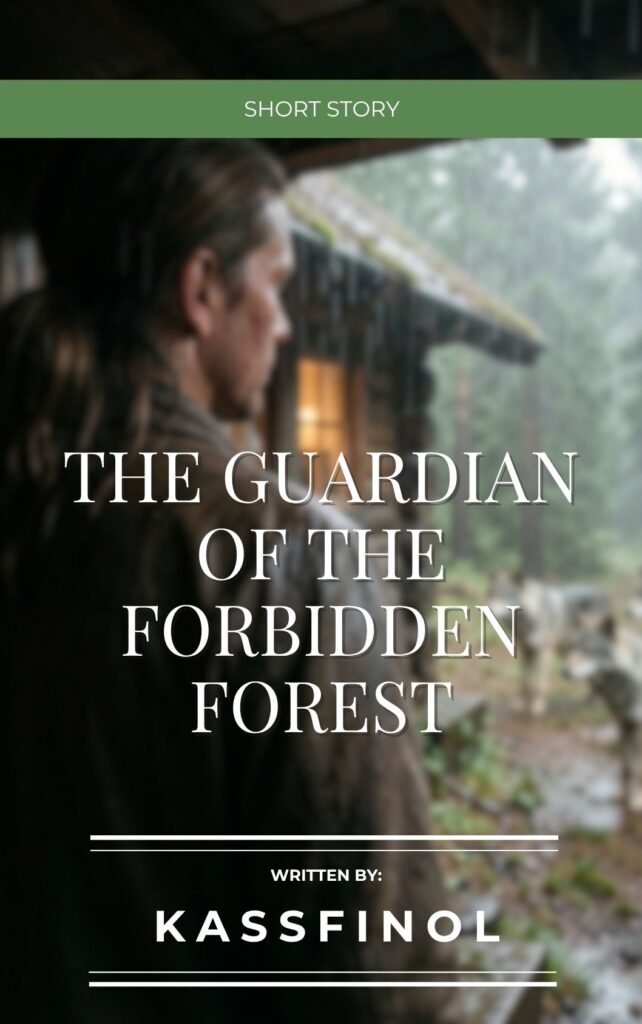
Title: The Guardian of the Forbidden Forest
Author: Kassfinol
Genre: Paranormal Romance
All rights reserved
Summary:
Emma Vargas wasn’t supposed to be in that forest. The sign made it clear. But after two months of rebuilding her life from scratch, a forbidden trail seemed like the most manageable problem of the day.
Until she needed someone to rescue her. And that someone turned out to be the kind of man who doesn’t fit into any known category: too still, too warm, too attentive in ways that have no normal explanation.
That forest has belonged to someone for a long time. What Emma didn’t know was that going in meant becoming, without planning it, something that was also worth guarding.
Chapter 1:
The first sign read REHABILITATION ZONE — DO NOT ENTER, and I ignored it with the same efficiency with which I had ignored every useful piece of advice given to me in the last six months.
How appropriate.
The trail narrowed about twenty meters past the orange barrier. The pines closed in above my head as if they were conspiring, and the afternoon sun reached the ground in fragments, not light, but reminders that outside the forest there was a world I didn’t want to go back to yet. I adjusted the backpack straps, which were eating into my left shoulder, and kept walking.
Marcos had been history for two months. What hadn’t been history for two months was the apartment we shared, the coffee maker that was his but that I used, the group of friends who were technically both of ours but who in practice had picked sides without needing a formal vote. Marcos’s side. Of course.
So this was what I had left: a national forest I wasn’t supposed to be in, a pair of trekking boots I bought three years ago and used exactly twice, and the completely unfounded conviction that walking alone until I ran out of breath was going to fix something.
Perfect plan. What could go wrong?
What went wrong took forty minutes to materialize.
There were three men. I saw them first among the trees, moving parallel to the trail with that kind of intention that has nothing to do with hiking. One of them, the tallest, wore an orange hunting jacket and looked at me as if he were calculating something. I didn’t know what until the trail turned and all three appeared in front of me blocking the way.
My brain, useful as always, took about three seconds to process the situation. Then it registered: isolated area, no cell signal for half an hour, a backpack weighing twelve kilos that would be impossible to manage if I needed to run.
Great.
—You’re on private land —said the one in the orange jacket. It wasn’t a warning. It was an opening.
I took a step back. One of the other two shifted to my left, cutting off the escape angle with an efficiency that told me it wasn’t the first time they’d done this.
I’m not going to describe the next three minutes in detail because part of me still prefers not to. What I will say is that the man in the orange jacket grabbed my arm hard enough to leave the bone of my elbow marked for four days, and that I did what I could: I screamed, I kicked, I threw the backpack hoping that twelve kilos of camping gear would do something to the one on the left.
It did nothing.
What did do something was the noise.
It came from the forest to my right: a sound between cracking branches and something deeper, more visceral, the kind of sound the rational brain doesn’t identify but something older does, something that lives at the base of the skull and recognizes predator before the prefrontal cortex finishes evaluating the situation.
The three men heard it too. I saw it in their bodies: the head of the one in the jacket turned half a second before I saw him.
Rowan.
I didn’t know his name was that until much later. In that moment I only saw size: at least six foot three, shoulders that made the nearest pine trunk seem discreet, and a facial expression that wasn’t fury but something colder, quieter, more absolutely terrible than fury. The kind of calm only things that don’t need to get agitated to be dangerous have.
He didn’t speak. He didn’t threaten. He gave no verbal warning of any kind.
What he did was walk toward the three men with the same calm with which I would have walked to the refrigerator at two in the morning, and in the next forty seconds, with an economy of movement that put my stomach in my throat, he dealt with all three.
The one in the orange jacket ran off first. The other two followed about ten seconds later, one of them limping.
Rowan stayed still where he was and looked at me.
I looked at him.
He had his right eye split open and it was bleeding from the eyebrow, but he didn’t seem to have noticed.
—Can you walk? —he said. His voice was deep and spare, the kind of voice that clearly considered words a resource not to be wasted.
I tried to take a step and my left knee informed me, very precisely, that my ankle had suffered during the struggle and that walking was going to be a complicated negotiation.
—Yes —I said anyway.
He looked at my ankle and then looked into my eyes. He raised an eyebrow, which was the most expressive I would see him be in a long time.
—No —he corrected, and before I could protest, he picked me up.
He did it without asking whether I was okay with it and without the slightest apparent effort, and my brain, which was supposed to be processing the recent trauma of the last forty minutes, decided instead to register other things: the heat of his body, which was more than the normal heat of an adult in motion, a deep and constant heat like a lit source; the smell, damp earth and pine resin and something darker that I had no catalog for in any previous sensory record; the way his arms held me, without effort, without hesitation, as if my weight were irrelevant to him.
I decided it was the trauma. Trauma did weird things to sensory perception. I’d read that somewhere.
I kept telling myself that during the twenty minutes it took us to get to the cabin.
The cabin smelled of damp wood, pine resin… that explained his body odor… and something harder to identify, something animal and clean at the same time, like earth after the rain, but with a component that had no name in my vocabulary. It was small: a single room with a wood stove in the center, a dark wooden table, two chairs, a bed against the far wall, and shelves reaching the ceiling loaded with books, jars, instruments I didn’t recognize right away.
He set me down on the bed with more care than I expected from someone that size and went straight to the stove.
I sat up and watched him.
In motion, without the urgency of the last forty minutes, I could see him better. Forty years old, more or less, although it was hard to know because he had that kind of carved face that could mean forty or could mean the outdoors made him look older than he was. The dark hair, too long, pulled back carelessly. The huge, calloused hands, handling the firewood with the same surgical precision with which he had handled those three men.
My freelance graphic designer brain —because that was me, Emma Vargas, graphic designer who made bad hiking decisions— tried to catalog him and found no category. He wasn’t a movie lumberjack. He wasn’t a national park ranger. He was something harder, more real, more out of scale. The kind of man who exists to give classification systems a problem.
—I should call someone —I said. It wasn’t a question.
—There’s no signal. —He added wood without looking at me—. And you’re not going anywhere tonight. There’s a storm.
As if rehearsed, the first lightning bolt lit the cabin windows at that precise moment. The rain arrived thirty seconds later, hard and sudden, hitting the wooden roof hard enough to drown out any other sound.
I looked at him and he returned my gaze. Meanwhile, outside, the forest disappeared behind a wall of water.
—So basically I’m trapped here? —I said.
—Basically. —There was no apology in his voice. It was a fact, not an apology.
—Great. —I closed my eyes for a second—. Great, great, great. And what exactly are you? The guardian of the forest? The bogeyman? Some intermediate category?
He looked up from the stove. He looked at me in that dense, quiet way of his, and didn’t answer.
—Okay —I said—. Silence, fine, we can do silence.
The silence we did, but it wasn’t comfortable. It was the kind of silence that occupies the same physical space as the people who inhabit it.
That first night I slept in his bed because it was the only bed and because my ankle was swollen enough that tilting my head down to look at it put me in a bad mood. Rowan slept on the floor, or so I assumed, because when I woke up at three in the morning with the storm still raging outside, he wasn’t inside the cabin.
Chapter 2
He was sitting on the covered porch, motionless, looking toward the forest.
I stayed watching him through the window longer than I would have admitted. There was something in his stillness that wasn’t peace: it was vigilance. The posture of something that is always alert, that has forgotten how to stop being so. His shoulders relaxed in a specific way, not the relaxation of rest but that of a predator that can move in any direction in half a second. The hard profile against the dark background of the forest, the rain erasing the clearing behind him.
I shouldn’t have been looking at him so closely. It was the kind of attention you pay to things that are starting to matter to you, and Rowan was a stranger in whose bed I had ended up through circumstance, not choice.
I moved away from the window before he turned around.
It took me another hour to fall back asleep, and not completely.
The second day dawned with the storm turned into fine, persistent rain, the ankle cataloged by Rowan —without asking me— as sprained, but not broken, and the situation that we still had no signal and the trails were muddy.
He brought me hot water and something that turned out to be an infusion of plants that smelled as if the whole forest had prepared it. He gave it to me in a dark ceramic bowl, and when I took it, his fingers brushed mine.
It was a fraction of a second. He didn’t register it, or if he did he didn’t show it.
I registered it with ridiculous precision. The heat of his fingers was the same as that of his body, that extra temperature that didn’t correspond to what it should be, and I stayed looking at the bowl a moment longer than necessary.
—What is this? —I asked.
—Anti-inflammatory.
—Homemade?
—Yes.
—And what if I’m allergic to something?
He looked at me.
—You’re not.
—How do you know that?
He didn’t answer. He got up and went to check something on the shelves.
—Fine —I murmured—. The silence again. Perfect.
What changed things was the wolf.
He brought it at dusk on the second day: a huge animal, silver gray, with its front left leg at an angle it shouldn’t be. He set it down on the table in the most delicate way I had seen him handle anything, which is saying a lot given that I had seen him basically knock out three men with his bare hands.
I looked at him. I looked at the wolf. I looked at Rowan.
—Do you need help? —I said.
He looked up with something that in another man would have been surprise and in him was only a fraction of a second of more pronounced stillness.
—Do you know about this?
—I have a cat —I said—. I’ve learned more than I wanted to about bandages and joints. And I took two years of biology before switching to design because it turned out insects seemed fascinating to me until I had to dissect them. So: more than the average person, less than a vet.
He nodded. He gestured toward the table.
We worked close together. Closer than the situation objectively required, although the space was small and the animal was in the center of the table and we both had to lean over it. At some point Rowan stretched over me to reach something from the shelf and his arm passed brushing my shoulder, and when he turned to hand me the jar his face was a few centimeters from mine.
He said nothing and neither did I.
The wolf looked at me throughout the process with yellow eyes that were clearer and more intelligent than they had any right to be. It didn’t growl. It didn’t try to bite me. It just watched me with that animal calm that at times seemed almost evaluative to me.
—Where do they come from? —I asked while Rowan finished the bandage—. Is there a pack here?
Something crossed his face. Fast, controlled.
—Yes —he said.
—Do you take care of them?
—I protect them.
It wasn’t the same thing, and we both knew it. I didn’t press him. I was starting to learn that Rowan was like the forest he guarded: there were things he revealed and things he kept, and pressing wasn’t the way.
That wolf wasn’t the last. Then he brought two more: a female with a wound on her side and a young one with something in its eye that Rowan cleaned with such delicacy that I had to look away because the image of that huge man with those huge fingers handling a cotton swab with surgeon precision did something to my chest that I preferred not to examine too closely.
I started helping without anyone asking me. I boiled water, prepared bandages, held animals. Rowan gave me instructions in his way, which consisted of minimal words and precise gestures, and I learned to read him the same way: unhurried, layer by layer.
What I discovered was this: he wasn’t a man without words. He was a man with very few that were worth saying, and he kept the rest silent because silence didn’t bother him the way it bothers most people. He had books on botany, ecology, animal biology. He knew the forest in a way that made my designer brain think in overlapping planes: he didn’t see trees but relationships, he didn’t see trails but corridors, he didn’t see rain but system.
Chapter 3
On the afternoon of the third day I was trying to reach a book from the upper shelves when I heard his steps behind me. I stretched my arm a little more and he, without saying anything, came over and took it down himself. We were face to face when I turned: he with the book in his hand, me with my arm still raised, the two of us at a distance that wasn’t uncomfortable but wasn’t neutral either.
He gave me the book.
His eyes were a dark amber, which was only possible at that distance. I had already noticed before, that color that didn’t correspond exactly to any human eye tone I had cataloged, but up close it was more evident: not brown, not golden, something in between that changed with the light as if there were something behind it moving.
—Thank you —I said.
He nodded and took a step back.
I don’t know why the step back bothered me. I had no right to be bothered by it. I opened the book and pretended I was reading for about ten minutes during which I retained nothing.
And there was a sadness in him that wasn’t new. It was old, worn, carried for a long time. The kind of sadness that no longer hurts sharply, but simply exists, as part of the body’s usual weight. I had been noticing it in the small spaces of silence, in the way he sometimes looked at the forest from the window as if he were remembering it instead of seeing it.
On the afternoon of the fourth day, while the rain persisted outside and we were both sitting near the stove, me with an ecology book I had taken from his shelves without asking permission, him carving something in wood with a small knife, I looked up and found him looking at me.
He didn’t look away immediately. He looked at me for two more seconds, direct and unapologetic, before going back to the wood.
Something adjusted in my chest. I didn’t identify it then. Or I did identify it and preferred not to.
—How long have you been here alone? —I said.
He kept carving.
—Long.
—By choice?
—Partly.
—The other part?
He looked up. He looked at me in that long, quiet way I already recognized as his way of evaluating how much truth the recipient could handle.
—Not everyone can live between two worlds —he said at last—. Sometimes the world chooses for you.
I didn’t understand what it meant. I would understand later. At that moment I stored it, I put it in that mental place where you put things you don’t understand yet but know are going to matter.
What he did next I didn’t expect: he reached out his hand and moved away from my face a lock of hair that had fallen forward while I read. A small, precise gesture, made with the calloused fingers that had carved the wood and bandaged the wolves. He didn’t explain it. He didn’t turn it into anything more than what it was.
I didn’t breathe during the three seconds it took.
He stayed looking at me when he finished and I returned his gaze, but then he went back to the wood as if nothing had happened.
It was undeniable, the temperature of the silence between the two of us had changed in a way we both knew and neither was going to name yet.
The night of the fifth day wasn’t planned by anyone.
The storm had picked up again. The fire in the stove crackled with an almost hypnotic regularity. We had eaten dinner in silence, which was our normal way, but there was something different in that silence: denser, more conscious. Charged the way the air charges before lightning.
I was standing looking out the window at the dark forest when I felt him right behind me. I didn’t hear him move: he was too silent for his size, which kept being disconcerting to me in ways I preferred not to analyze. I felt it in the heat that preceded his presence, in that change in air pressure that shouldn’t be perceptible, but was, in something under the skin that recognized his closeness before my head registered it.
I turned around.
He was too close. Or the distance was what it had always been and I was the one who had changed the way I measured it.
—Rowan —I said. I didn’t finish the sentence because I wasn’t sure what was going to come next.
His eyes were dark in the firelight, amber with glints my brain still couldn’t catalog. They looked at me in that way of his, but without the usual clinical distance: they looked at me for real, as if what they saw mattered in a way he had stopped allowing himself to do a long time ago.
He raised a hand and put it on my cheek with an almost absurd care, considering the size of that hand, considering everything I had seen done with those hands.
—I can stop —he said. Two words. Just enough.
—No —I said. One. Just enough.
He kissed me slowly. Not with urgency, not with the efficiency he applied to everything else: with a methodical and overwhelming attention that made it hard for me to stay on my feet. His mouth was warm and tasted of wood and night and that dark, indescribable thing I had spent four days trying not to notice in him, and when he finally pulled away he did so only enough to look at me, to make sure of something I don’t know exactly what it was.
I put my hands on his chest. The heat through the fabric was the same as always, that extra temperature that had no normal explanation.
—I’m still me —he said, quietly, as if he knew there were things I needed to have named first.
—I know —I said.
He kissed me again. This was different: deeper, more deliberate, the kind of kiss that leaves no room for thought. His hands found my hips and moved me backward toward the bed with that economy of movement of his I already knew, without hurrying, without stumbling, without anything out of place.
He took off my clothes unhurriedly. First the sweater, and when he passed the fabric over my head I was left with the cold of the cabin air on my back and his heat in front, and the contrast was one of those you register with your whole body. He undid the buttons of the inner shirt one by one, as if each one required the same attention as the last, and I stayed looking at his hands because they were the safest of the things I could focus on at that moment.
—You too —I said.
A pause. He looked at me. Then he unbuttoned his shirt and let it fall.
What was underneath was what I expected and at the same time it wasn’t what I expected. The width of the shoulders was obvious, the scars weren’t. He had three, one on his ribs and two on his right arm, old and smooth, the kind that no longer says what caused them. I touched them with my fingertips without asking permission. He let me do it.
—How many more are there? —I asked.
—Enough.
He laid me down on the bed. He positioned himself above me and his controlled weight was exactly what it was: controlled, calibrated, the same man who measured everything he did. The fire in the stove warmed the side of the room. The rain kept hitting the roof.
He lowered his head and kissed my neck, and then my collarbone, and then lower, with the same calm he applied to everything. His hands traveled the contour of my ribs, my waist, with that extra temperature of his that made my skin go on alert in every place he touched.
When he got down there he took off what was left of my clothes and looked at me a moment, that dark amber fixed on me in the half-light, and something in that look was hunger and something was another thing older than hunger.
He lowered his fingers slowly between my legs and I exhaled against his shoulder.
He moved them with the same precise attention with which he did everything else: reading each response before adjusting, unhurried, although I was starting to lose my composure, without speeding up, although it was clear he could do it. It was maddening in a specific way, the kind of attention you don’t know whether you want to stop or never stop, and when I made an involuntary sound against his neck he didn’t turn it into triumph: he continued, constant, reading.
—Rowan —I said.
He looked at me. His fingers didn’t stop.
—Don’t stop —I said, and what I was also saying was I want you inside, and he understood it anyway, because he was that kind of man, the one who doesn’t need things spelled out.
He moved up over me and when he opened me it was in a long, firm movement that made the air leave my lungs all at once. I arched with my fingers dug into his back. He stayed still a moment, his forehead against mine, breathing. I felt all his weight and all his fullness and something more, something in my chest that tightened in a way that wasn’t only physical, the kind of pressure that comes from recognizing something you didn’t expect to recognize.
He started to move.
The rhythm was his: deliberate at first, so deliberate it was almost unbearable, building something without any hurry. The old wood of the bed marked the beat against the wall. His heat was the kind that penetrates, not only the skin but deeper, the right kind, the kind that makes it hard to count how much time has passed. His hands held me at a moment when I needed to be held and they did it as if they knew it before I knew it.
And when he finally opened his eyes and looked at me they had that amber, the one that didn’t correspond to any human color I had seen, lit in the half-light of the fire, and I didn’t think. It wasn’t the moment to think. It hadn’t been the moment to think for a while.
The rhythm changed. What had been building was long and took me by surprise in its intensity, the kind of arrival that leaves you without resources for a few seconds, that empties you before returning you. I clung to him. I felt his fingers tighten on my hip.
He came shortly after with a sound that started in his chest and ended up being something more than a voice: a vibration, deep and resonant, that trembled in the cabin’s wood and went out through the windows into the dark forest, where something answered in the distance.
I stayed listening to that echo without identifying it.
Afterward he was still, with his weight partly on me and partly to one side, his breathing recovering. His hand found mine on the mattress without either of us deciding it. His fingers intertwined with mine.
He didn’t speak. Neither did I.
Outside, the forest kept speaking in its language while the rain persisted.
Chapter 4
On the sixth day the men came.
I saw them before he heard them, which should have seemed impossible to me given that he heard things at distances that didn’t correspond to any human hearing threshold. They were at the edge of the tree line: four, six, more, with rifles and that kind of concentrated intention that made my stomach close up all at once.
—Rowan.
He was already on his feet. He had already heard something I hadn’t.
He turned to me with an expression I hadn’t seen before. It wasn’t fear, it was something more complex: urgency mixed with something very much like apology.
—There’s a passageway —he said—. Behind the back shelf. It takes you to the riverbank. Follow the river north and in forty minutes you reach the road.
I looked at him.
—No.
—Emma.
—I’ve said no. —I crossed my arms. My ankle still hurt when I put my full weight on it, but it was functional—. I’m not going off alone through a passageway while you stay here alone against whatever those are.
—I can handle them.
—There were three the first time and you almost lost an eye.
—There were six and the result didn’t change.
I had no answer for that, so I grabbed the shotgun that was leaning against the wall by the door because I had seen it there since the first day and knew enough about how it worked thanks to a boyfriend from five years ago who was a hunter.
Yes, yes, I’m terrible at choosing partners. I know.
—Emma. —His voice was low, urgent—. You don’t know what’s going to happen here.
—No. But I’m staying.
The first shot came before we could keep arguing.
It broke the left window and Rowan threw me to the floor with an arm across my torso so fast my brain took two seconds to register that I was on the floor and that he was bleeding from the shoulder.
One shot. It had hit him.
—Rowan.
But he was on his feet again. And something in his posture had changed: it was no longer the usual quiet calm. It was something older, denser, that filled the space of the cabin in a way that wasn’t physical and yet made the air have a different weight.
—Get out through the passageway —he said. His voice had harmonics it shouldn’t have. It resonated in the wooden floor—. Now.
—What are you going to—?
He started to change.
I’m not going to describe it well because there is no correct vocabulary for this. What I know is that it was fast. That it sounded: bone relocating, joints giving way in directions that didn’t correspond to any anatomy I had studied in those two years of biology. That the clothes didn’t hold. That the fur came out dense and silver gray from skin that stopped being skin with an efficiency my brain processed as this has happened before, many times before I could panic. That the man who had been beside me became something else and didn’t fit well in the cabin, and that what disturbed me most wasn’t the size, but that at no point in the whole process did he stop being, in some way I can’t explain, completely him.
I looked at him.
He looked at me. With amber eyes I recognized.
I turned, grabbed the shotgun, opened the side door, and took up the cover position in the doorframe while the wolf passed over me toward the outside with a sound that made the trees at the edge of the forest tremble.
What followed was chaotic, noise, screams, the shotgun fired twice toward the only man who had the bad idea of aiming in my direction, the dark forest filling with sounds that weren’t human and weren’t entirely animal. I stayed in my position. I covered the retreat of a thing I couldn’t name and that was at the same time the man who had held my hand in the dark.
In the end it was silence. The kind of silence that comes after noise and weighs twice as much.
The men had gone. Most of them running, carrying the others.
The wolf returned to the edge of the forest and looked at me from there for a good while. Then it disappeared among the trees, and when it came back to the cabin a few minutes later it was Rowan, exhausted and still bleeding from the shoulder, leaning on the doorframe more than usual.
I looked at him for a few seconds and then I broke the silence:
—The shoulder —I said—. Let me see it.
He said nothing. He sat in the chair because that was what you do when you lose enough blood. I went to get the materials I already knew from having spent several days helping him with the animals of his pack.
His pack. Of course.
—You should be running away —he said while I cleaned the wound.
—I’ll do that when I finish this.
—Emma.
—Rowan. Shut up and let me stitch you.
He shut up. I stitched him. His eyes on my face the whole time, that familiar weight I had already learned to feel without needing to look up.
When I finished I didn’t move away. I put a hand on his jaw, my fingers on the side of his face, and turned him to see the eye that had been left swollen from the first blow. He allowed it. He closed his eyes for a moment under my hand, as if the pressure of my fingers were something he needed more than the bandage.
I held him like that for a few seconds.
Then I moved away because if I didn’t move away I was never going to, and one of the two had to keep some sense.
—Tomorrow we need to talk —I said.
—I know.
—About everything.
—I know.
I left him sitting by the stove with instructions not to move his shoulder more than necessary, which we both knew he was going to ignore, and went to get water.
Chapter 5
The next morning I walked out of the forest, even though my ankle protested the whole way, but I didn’t care.
It took me three days to have all the conversations I needed to have: with the police, with the emergency services, with the national park agent who wanted to know what I was doing in a restricted access area. I told them about the three men from the first night, about the siege, about the shots. I signed statements. I identified photos. The men in the orange jacket had records. What I had seen that night was going to be enough for charges of assault, trespassing, illegal possession of weapons.
I didn’t mention Rowan. I didn’t mention the cabin. I didn’t mention anything that would have to be explained in ways that had no correct words.
The park agent looked at me across the desk with that kind of educated suspicion officials have when they know something doesn’t add up, but can’t prove which piece is crooked.
—And you spent those days alone in the forest? —he said.
—Not entirely —I said—. There’s a wildlife sanctuary in there. They need volunteers.
The agent looked at me three seconds longer than necessary, nodded, and closed the folder. He didn’t ask more questions. I assumed that after enough years patrolling that forest, you learn not to ask them.
I went back to the forest two weeks later. Not as a lost person, not as a victim, not following the urgency of a breakup that was already far enough away not to hurt sharply. I went back with boots that fit me well this time, with a backpack packed to stay, with the volunteer application papers for the wildlife sanctuary that technically didn’t exist in any official record, but that I was going to make exist if necessary.
The REHABILITATION ZONE sign was still there. I passed it again, this time without ignoring it exactly: I simply knew that what was on the other side was worth the restriction.
Rowan was on the cabin porch when I arrived. He saw me coming long before I reached the clearing… of course.
He didn’t receive me with words. He received me in his way: still, evaluating me, with that weight in his eyes I had already learned to read as what it was.
—You said not everyone can live between two worlds —I said when I was close enough—. That sometimes the world chooses for you.
He nodded.
—I’m choosing —I said—. If that changes anything.
He looked at me for what should have been an uncomfortable amount of time, but it no longer was. The forest made its noises around us, wind in the treetops, something moving among the trees at the edges of the clearing.
—It changes things —he said at last.
—Good.
He moved aside at the cabin entrance. It wasn’t exactly a verbal invitation, but it was Rowan: he did just enough and left the rest in the air for whoever wanted it to take it.
I went in.
Outside, at the boundary where the clearing became forest, something big and silver gray moved among the shadows and then stayed still, guarding. I recognized it: the female from the first night, the one we had healed together on the table, the one who had looked at me with those too-intelligent eyes while I held her paw.
Second in the pack, according to Rowan.
So Rowan also had someone watching his back. I was glad to know it.
I closed the door.
The End