
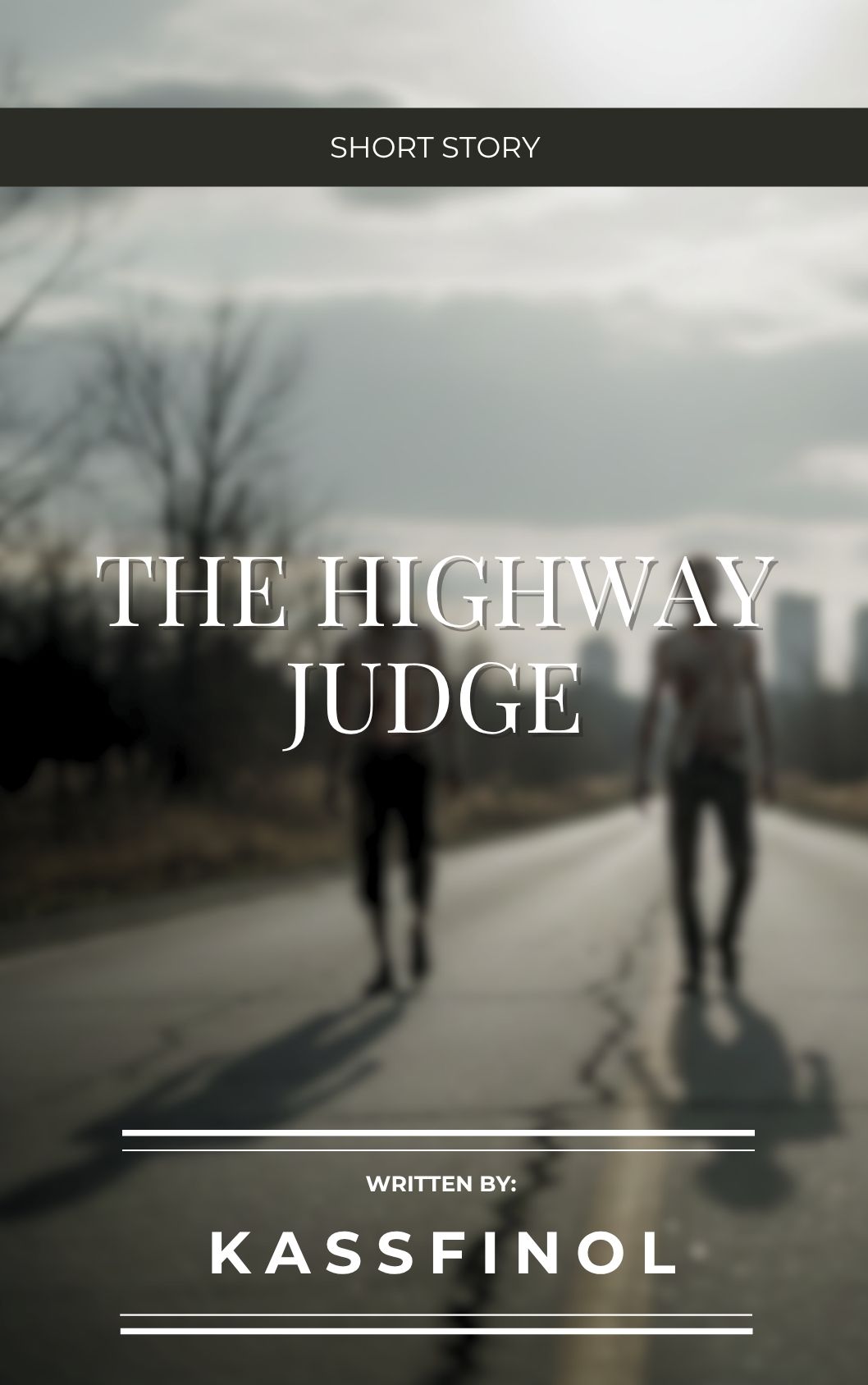
Title: The Highway Judge
Author: Kassfinol
Genre: Post-apocalyptic fiction – Existential drama – Dirty realism
All rights reserved
Dust rose in gray columns behind the convoy. Three vehicles: a Hilux pickup with a rusted body, a black SUV with cracked tinted windows, and a sedan dragging its exhaust. Gerardo gripped the Hilux’s steering wheel and spat out the window. The air smelled of ash and burnt gasoline.
—How much do we have left? —he asked without turning his head.
Laura checked the gauge from the passenger seat.
—Half a tank. Enough to reach Riverside if we don’t stop.
—We’re not stopping.
In the back seat, the old man coughed. A wet cough that made Gerardo grit his teeth. Héctor was seventy-two years old and every breath sounded like crumpling paper. His hands trembled over a canvas backpack he wouldn’t let go of, not even to piss.
—You should let me check that —Laura said, pointing at the backpack.
—Don’t touch my things, girl —the old man growled. Another cough. Blood at the corner of his lips.
Gerardo sped up. The highway was empty except for the skeletons of abandoned cars on the shoulders. Some still had corpses inside, mummified by the sun; people didn’t even bother burying them anymore.
The checkpoint appeared two kilometers later.
A barricade crossed both lanes: tires, metal beams, a hand-painted sign that read STOP – MANDATORY INSPECTION. A man stood in the middle, wearing a yellow reflective vest over military clothing. He had a rifle slung over his shoulder and a badge shone on his chest.
—Shit —Gerardo hissed.
—Who the hell…? —Laura leaned forward.
The man raised a hand. The other rested on the rifle. Gerardo braked twenty meters away. Behind them, the SUV and the sedan stopped too, the dust catching up with them like a wave.
The man walked toward them. His boots struck the asphalt with a military rhythm. When he reached Gerardo’s window, he leaned slightly. He had a sun-weathered face, gray eyes that didn’t blink, and a smile that went nowhere.
—Good afternoon —he said. His voice was calm, almost kind—. I’m the Judge. I need you to turn off the engines.
—We don’t have time for this —Gerardo answered—. We have to reach Riverside before nightfall.
—Turn off. The engines —he insisted slowly.
He didn’t raise his voice. He didn’t have to. Gerardo saw the Judge’s finger caress the rifle’s trigger and turned the key. The silence that followed was worse than the engine.
The Judge walked backward, observing the three vehicles. He stopped at each one, looking through the windows. When he returned, he took a notebook out of his vest pocket.
—Three vehicles. Nine occupants. —He wrote something down—. You’re going to need to justify the consumption.
—Justify what the hell? —Gerardo threw the door open.
The rifle pointed at his face before he could get out.
—Stay where you are —the Judge said—. And answer the question. What are these vehicles doing on the highway?
Laura put a hand on Gerardo’s arm.
—We’re going to a military base. We have vital information.
—Information? —The Judge lowered the rifle, but didn’t let go of it—. What kind? What do you mean?
—That’s none of your business —Gerardo growled.
The Judge looked at him for three full seconds. Then he nodded.
—Get them all down. I want to see them. —the threatening tone was felt strongly.
The nine survivors formed a line beside the vehicles. The sun crushed their heads. The Judge walked in front of them with the notebook, stopping before each one.
First Gerardo. Thirty-five years old, marked muscles, scars on his knuckles.
—Occupation?
—Soldier. Former Marine.
The Judge wrote it down. Next.
Laura. Twenty-eight years old, thin, hands dirty with grease.
—Mechanic. I keep the vehicles running.
Notation. Next.
Ramírez. Forty years old, unkempt beard, firm hands.
—Doctor. Surgeon before everything went to hell.
—Useful —the Judge murmured.
He continued. Chen, electrical engineer. Kovac, communications specialist. Two more from the sedan: Torres, nurse, and Díaz, also a mechanic. They all had something to offer. All except the last one.
The Judge stopped in front of Héctor. The old man coughed, spat blood at his feet. His eyes were yellowish.
—Name.
—Héctor Salinas.
—Occupation?
The old man didn’t answer. He hugged his backpack tighter.
—I asked you a question.
—He was… he was an archivist —Laura intervened—. He worked with classified documents.
—Was? —The Judge looked at the old man—. And now?
Héctor coughed again. He said nothing.
The Judge closed the notebook.
—This man is consuming resources he can’t give back. He’s sick. He’ll die in days, maybe hours. —He turned to Gerardo—. Why are you taking him?
—He has information —Gerardo said through his teeth—. In his head.
—What information?
—The coordinates of a military facility. Underground. It has supplies for years, weaponry, satellite communications. —Gerardo took a step forward—. It’s our only chance to rebuild something… or to keep surviving.
The Judge looked at the old man. Then at Gerardo.
—Can he write them down?
—No —Laura shook her head—. We already tried. He’s… confused. He only remembers them when he’s close. He says he’ll know when we get to Riverside.
—Convenient —the Judge smiled without humor—. And if he dies first?
Nobody answered.
The Judge walked toward his barricade. He took a bottle of water from a box and drank slowly. The survivors watched him. The sun turned their shadows into black puddles.
—You have an efficiency problem —he said finally—. This convoy consumes fuel and water for nine people. Eight of you contribute to the group’s survival. One is dead weight. —He pointed at Héctor—. Seventy kilos of useless meat. Every liter of gasoline you use to move him is a liter stolen from the future.
—He has the coordinates —Gerardo repeated. His hand moved toward the pistol on his belt.
The Judge’s rifle was already pointing at him.
—Don’t do that… I don’t think it suits you —he spat to one side.
The silence stretched. A fly buzzed around Héctor’s mouth.
—Let me explain how this works —the Judge said—. In the old world, the rules protected the weak. We kept them alive because we could afford the luxury. —He spat—. That world died. Now only the efficient survive. Those who contribute. Those who deserve every gram of food, every drop of water.
—He’s a sick old man —Ramírez said—. You can’t…
—I can… of cooourse I can… And I will. —The Judge lowered the rifle—. But I’m fair. I’ll give you a choice.
The Judge pointed at the highway to the east.
—Riverside is a hundred kilometers away. That man can walk. If he arrives alive, he’ll have proven he’s worth spending on. If he dies… —he shrugged—. Nature will have decided.
—He’s crazy —Laura hissed.
—I’m sane —the Judge corrected—. I’m the only sane one left. You keep acting as if the old rules mattered. As if compassion were anything more than a slow suicide.
Gerardo pulled out the pistol. The Judge didn’t move.
—Go ahead —he said—. Shoot me. Then figure out how to get past the barricade without blowing up your pickup. Oh, and explain to your companions why wasting a bullet on me was more important than reaching Riverside.
Gerardo trembled. The barrel pointed at the center of the Judge’s forehead.
—Gerardo —Laura whispered—. No.
Héctor coughed. He leaned forward, clutching his chest. Blood dripped from his chin.
—I… I can walk —he said in a broken voice.
Everyone turned toward him.
—Don’t talk nonsense —Gerardo lowered the gun—. You won’t last ten kilometers.
—I can… —another cough—… try.
The Judge nodded.
—A sensible man.
—No! —Laura stepped between them—. This is wrong. We can’t leave him.
—Would you rather everyone die? —the Judge asked—. Because that’s the alternative. You’re carrying a dying man in your convoy. When he collapses, you’ll stop. You’ll lose time. You’ll spend resources keeping him comfortable while he agonizes. —He approached Laura—. And when he finally dies, you’ll have wasted gasoline, water, and energy on nothing. On a corpse that didn’t give you the coordinates.
Laura wanted to hit him. Her hands closed into fists.
—What if the coordinates are in his backpack? —she spat—. What if everything is written there and you just condemned humanity, you son of a bitch?
The Judge looked at the backpack. Then at Héctor.
—Open it.
—No —the old man stepped back.
—Open it or I’ll open it.
Héctor hugged the backpack. His eyes were crying, but not from sadness. From rage.
—It’s mine… my life… all that’s left…
The Judge tore it from his hands. Héctor screamed, lunged forward, but Gerardo held him. The old man writhed, weak as a bird.
The Judge opened the zipper. He took out the contents and dumped them on the ground.
Photographs. Dozens of old photographs, faded by the sun. A smiling family on a beach. A young woman in a wedding dress. Children playing in a garden. No paper with coordinates. No map. Nothing.
The silence was absolute.
—My God —Ramírez whispered.
Héctor cried on the ground, gathering the photos with trembling hands.
—My… my family… my Elena… my grandchildren…
Laura looked at Gerardo. Gerardo looked at the Judge. The Judge put away his notebook.
—There are no coordinates —he said calmly—. There never were. You were just carrying an old man who wanted to die near something that reminded him he was once human.
The Judge moved two tires from the barricade. He opened enough space for one vehicle to pass at a time.
—You can go —he said—. Or you can stay and argue about morality. But the sun is setting.
Nobody moved.
Héctor was still on the ground, holding a photo of his wife. The blood from his mouth stained the corner of the image.
—I… I lied to you —he murmured—. I thought that… if I had something important… if I was necessary… they’d keep me alive until we got there… —he coughed—… until we got to where she lived. Where we were happy.
Laura knelt beside him.
—There’s no base? There’s nothing?
The old man shook his head.
Gerardo hit the Hilux’s hood. The metal echoed in the silence.
—Son of a bitch —he whispered—. You made us waste fuel. Time. Everything for your goddamn memories.
—I’m sorry… —Héctor could barely speak—. I just wanted to see Riverside one more time before…
He didn’t finish the sentence. His body slumped forward. Laura held him, but he wasn’t breathing anymore. His open eyes looked at the photo in his hand.
The Judge observed the body for a moment. Then he turned to Gerardo.
—Do you see now? Ninety kilometers of gasoline. Three days of water rations. All to take a liar to his funeral. —He pointed at the corpse—. This is what kills humanity. Not the infected. Not the lack of resources. This… the disgusting, filthy sentimental weakness.
Gerardo didn’t answer. He got into the Hilux and started the engine. The other vehicles followed him through the barricade one by one.
When the last one disappeared down the highway, the Judge dragged Héctor’s body to the side. The photos spread over the ground, scattering in the wind. He didn’t pick them up.
He returned to his post and took out the notebook. He wrote: Convoy of nine. One eliminated. Efficiency restored.
He closed the notebook and waited for the next vehicle.
That night, Gerardo stopped the convoy thirty kilometers before Riverside. They camped beside an abandoned building. Nobody spoke during dinner. The water rations felt heavier in their hands.
Laura sat by the campfire, watching the flames.
—Do you think he was right? —she asked in a low voice—. The Judge?
Gerardo didn’t look at her.
—I don’t know.
—Héctor was a person.
—Héctor was a lying dead weight —he answered without thinking.
—He was both —Ramírez said from the shadows—. And that’s why it’s so frightening. Because maybe the Judge is right. Maybe the only way to survive is to stop being human.
Nobody answered. The fire crackled. In the darkness, something howled in the distance. It could have been a wild dog or it could have been something worse.
Laura wondered what would happen if any of them got sick, if any of them became useless… She wondered who would do the math then? Who would decide which life deserved gasoline? Who among them should be a judge?
She looked into Gerardo’s eyes and became distressed, because maybe he was thinking the same thing.
And on the highway, seventy kilometers away, the Judge lit a flashlight and checked his notebook. He knew that in a short time he would see more vehicles coming, he would have to make more decisions and keep restoring the efficiency the current world lacked so much.
He smiled in the darkness.
Someone had to do the dirty work.
Someone had to be the judge.
The End
You can read more of my short stories for free at: