
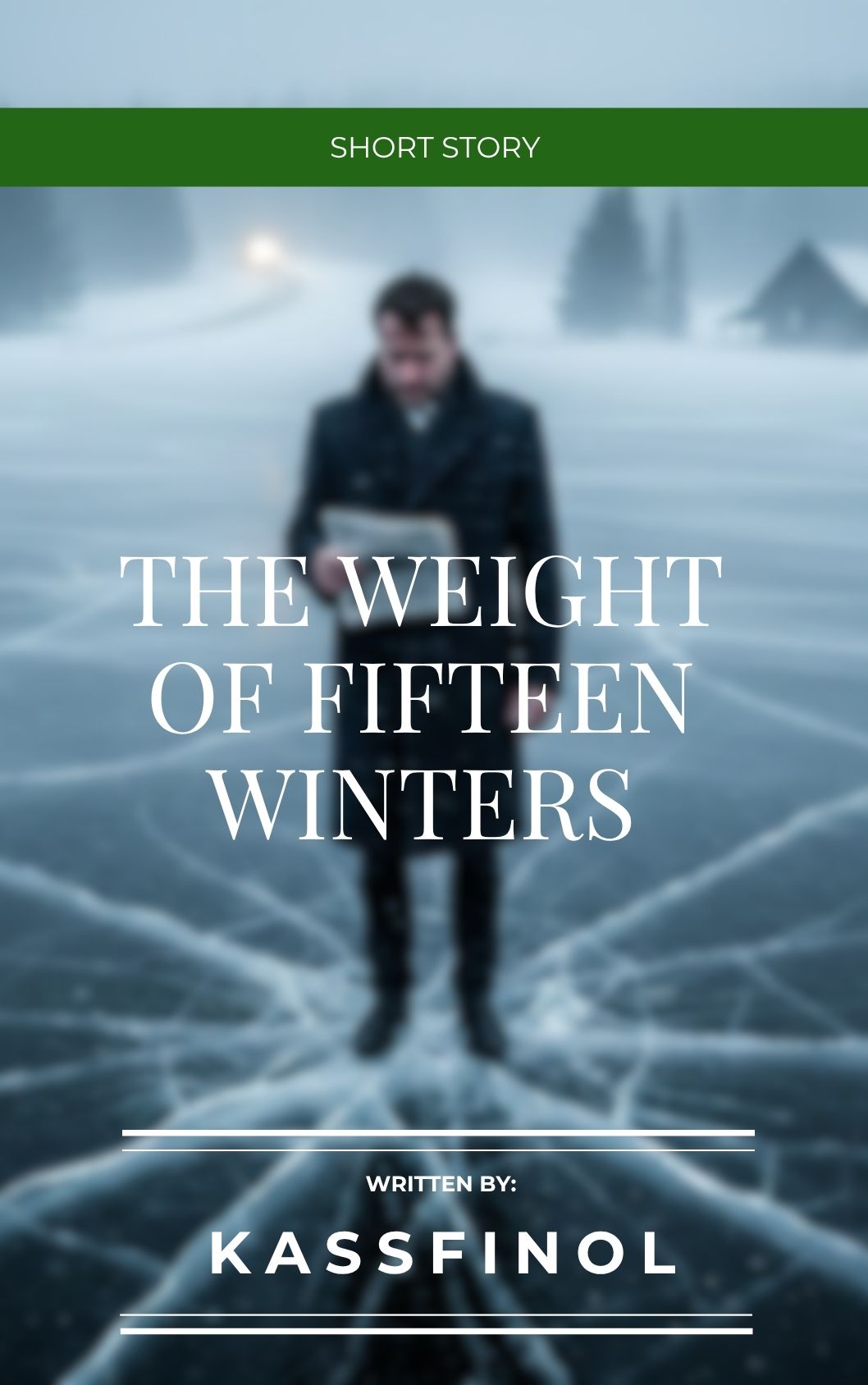
Title: The Weight of Fifteen Winters
Author: Kassfinol
Genre: Psychological thriller – Mystery – Drama
All rights reserved
David’s gravestone still has no name engraved on it when I notice my hands are shaking, and it’s not because of the cold.
I’ve been standing for ten minutes in front of the mound of fresh earth, watching the snow try to cover it without success. It’s brown earth, almost black where it’s wet, and it reminds me of the coffee David and I stole from his mother’s kitchen when we were twelve. We’d sit in the cabin by the lake, coughing because we drank it without sugar to feel like adults. Now David is under that earth and I’m still here, coughing metaphorically, pretending to be an adult.
The cemetery is emptying fast. The storm coming from the north isn’t the typical December snowfall; it’s a white, furious wall that has already swallowed the tops of the pines. Father Méndez passes by me, stops, squeezes my shoulder harder than necessary.
—Elías, son, you have to leave now. They’re going to close the road.
—Uh-huh —I say, without looking at him.
—Seriously. This is no joke. You could get stuck here for days.
I let out a laugh that sounds like a sick dog barking.
—How convenient.
Father Méndez looks at me as if he wants to say something more, but he doesn’t. He just sighs and walks quickly toward his truck. I watch him drive off, disappear around the curve. The others left a while ago. David’s mother didn’t even stay until they lowered the coffin; she left crying, leaning on her sister, without looking at me once.
Now I’m alone. Me, David under the earth, and this storm advancing as if it were coming specifically for me.
I put my hands in the pockets of my city coat, a stupid coat, of expensive wool I bought in a boutique where the clerk called me “sir”; and I feel the car keys. I take them out and look at them; they shine in my palm like a promise of escape.
—Happy Boxing Day, David —I say out loud, and my voice sounds obscene in this silence—. Perfect day to die, right? Right after Christmas, when everyone is fed up with pretending to be good people.
The wind pushes me from behind. Literally. It makes me take two steps forward and I almost fall onto the grave; I straighten up and feel my heart beating in my throat.
—Okay, okay, I’m going —I murmur, as if the wind were hurrying me.
I walk toward my car. It’s a gray Audi, as out of place in this town as I am. It cost me six months’ salary and I bought it because I wanted my new life to look good from the outside. What an idiot. I open the door and get in, closing it with a slam. The silence inside is worse than the wind outside.
I put the key in the ignition and turn it.
Click.
Nothing else.
—No —I say.
Click, click, click.
—No, no, no, no…
The dashboard blinks as if it were winking at me. The lights turn on and off, on and off. I laugh a hysterical, broken laugh that comes out of my chest like vomit.
—Of course —I tell the dashboard—. Of course. Fifteen years without coming and the universe decides I need to stay… this is veeery subtle.
I hit the steering wheel with both hands. Once, twice, and this makes my knuckles hurt. I like the pain; it reminds me I still feel something.
I look through the windshield. The storm has arrived. I can’t see the road, I can’t see the gravestones. I only see white, white and more white, as if someone had erased the world with correction fluid.
And then I know exactly where I have to go.
I don’t want to go there. Every cell in my body screams at me not to go, but my hands are already opening the door, my legs are already getting out of the car, and my body moves on its own, as if after fifteen years of running, it had finally gotten tired of fleeing.
The cabin is twenty minutes’ walk from the cemetery on a normal day. Today it takes me forty-five, and by the time I get there my lips are split, my cheeks are numb, and I’m sure I lost at least one toe to frostbite.
But I get there.
The cabin looks worse than I remembered. The door hangs from one hinge, half the roof has collapsed, and there’s graffiti on the outer walls: hearts, names, insults. “Karla is a whore.” “The class of 2019 rules.” “Fuck your mother if you read this.”
I push the door with my shoulder and it gives easily, I almost fall inside. The smell hits me immediately: dampness, rot, old urine. It was obvious someone used this as a public bathroom.
—Home, sweet home —I say, and my voice bounces off the empty walls.
I stand in the middle of the cabin, looking around. The table where David and I carved our initials is overturned in a corner. One of its legs is broken. There’s trash everywhere: beer bottles, used condoms, a syringe.
I feel like throwing up. This was our place, our kingdom. Here we decided we’d be best friends forever, that we’d never separate, that when we grew up we’d live together in a big city and have important jobs and laugh at this shitty town.
Lies. All lies.
I’m about to leave when I see it.
A metal box, the size of a shoebox, on a fallen beam. It’s rusty, but I recognize the drawing on the lid: an eagle David drew with a permanent marker when we were thirteen. He said the eagle was us, flying above everyone else.
I approach and my hands tremble when I lift the lid. Inside there’s a newspaper clipping, folded so carefully that the corners are perfectly aligned. I take it out and unfold it.
My stomach drops to the floor.
“Tragic Accident at the Lake: Minor Dies on Christmas Eve”
Below the headline there’s a photo of Ana María. She’s fourteen in the photo, but she looks younger; she wore pigtails, smiled, and had braces.
I can’t breathe.
I read the article, although I know it by heart. Every word is engraved in my brain like a scar.
“Ana María Ruiz died on the night of December 24th after falling through the ice of the municipal lake. Witnesses report the minor used to skate on the lake despite her parents’ warnings. Authorities determined it was an accident. No one else was present.”
A lie. The whole damn paragraph is a lie.
I flip the clipping over and my heart stops.
There are notes written by hand in the margins. David’s handwriting. That horrible, slanted, cramped handwriting the teachers always criticized.
“He left the next day.”
“He never called me again.”
“Not even once in 15 years.”
“How does he sleep at night?”
“I can’t.”
“I never could.”
The last line is written in different ink, more recent:
“Elías: if you’re reading this, it’s because you finally came back. Or because I’m dead. Probably both.”
My knees give way and I fall to the floor. The clipping slips from my hands, floats in the air for a second before falling. I bring my hands to my face and breathe. Well, I try to breathe, but it’s like someone put a plastic bag over my head.
—I’m sorry —I whisper between my fingers—. David, I’m so sorry. I’m so very sorry.
But “I’m sorry” means nothing. They’re empty words. David needed them fifteen years ago, when he was still here, when he could still do something with them. Now they’re dead, just like him.
I stay there, on the dirty floor of this ruined cabin, crying for the first time since I got the call. I didn’t cry at the funeral, nor on the plane, nor did I cry when I saw David’s mother collapse over the coffin, but now I cry. I cry like a child. I cry like I cried that night fifteen years ago, hidden in my room, biting the pillow so no one would hear me.
Christmas Eve, fifteen years ago.
David, Ana María, and I were at David’s house watching a terrible Christmas movie. Something with Will Ferrell. David’s mother made us hot chocolate and cookies, and told us to behave while she went to Midnight Mass.
As soon as she left, David turned off the TV.
—This is boring —he said—. Let’s go to the lake.
Ana María wrinkled her nose.
—Are you crazy? It’s horribly cold.
—Exactly. That’s why nobody will be there. We can test if the ice holds.
—David, no —I said—. It’s dangerous.
—You’re a chicken, Elías.
—I’m not a chicken. I’m sensible.
—Same shit.
Ana María laughed. It was a nervous laugh, but she laughed.
—I’m going —she said—. Anyway, my parents think I’m at Mass, so I have time.
And that’s how we ended up at the lake. So simple. So stupid. David said “let’s go” and we went, because that’s what we did. David said, we followed.
The lake was completely frozen. The surface shone under the full moon like a black mirror. David was the first to step onto the ice. He jumped a little, testing it.
—It’s solid —he shouted—. Come on.
Ana María looked at me.
—Are you coming?
—If you go, I go —I said, because I was a sixteen-year-old idiot trying to impress a girl.
We walked toward the center of the lake. Slowly at first, then faster. David laughed, shouted, struck ridiculous poses. Ana María took photos of him with her phone. I followed them, my hands in my pockets, feeling uncomfortable, but saying nothing.
And then we heard the crack.
It wasn’t loud. It was low, deep, like a sigh from the earth.
Ana María froze. Literally stopped moving. Her eyes opened wide.
—What was that?
—Nothing —David said, but his voice sounded tense—. It’s normal. Ice always makes noise.
—David…
—It’s fine. Just walk back. Slowly.
Ana María took a step. The ice cracked again. This time louder. She looked down and saw the crack. It was thin as a hair, but it was there, spreading from her feet like a spiderweb.
And she panicked.
—I’m going to fall! —she shouted, and started running.
—NO! —David and I shouted at the same time.
But it was too late. The ice broke under her feet with a sound like exploding glass. Ana María disappeared. One second she was there, and the next there was only a black hole in the ice.
David and I ran toward the edge. We threw ourselves face down, looked inside. The water was dark, opaque. We couldn’t see anything.
—Ana María! —David shouted—. ANA MARÍA!
Nothing.
—We have to call someone —I said, taking out my phone with trembling hands.
David grabbed my wrist. His grip was strong, painful.
—No.
—What?
—We can’t call. Don’t you understand? If we call, they’ll know we were here. They’ll know we brought her.
—David, she’s drowning…
—She already drowned, Elías. How long has she been down there? Two minutes? Three? She’s already dead. Calling won’t change that.
—But…
—What will change is our life. If we say we were here, they’ll blame us. They’ll say we pushed her or did nothing to save her. They’ll ruin us. Is that what you want?
I looked at him. I saw the fear in his eyes. The same fear I felt. And I nodded.
I nodded.
We ran away. We left Ana María there, in the black water, under the ice. We separated in town. Each to his own house. We didn’t talk on the way. We didn’t say goodbye.
That night I didn’t sleep. I stayed awake, looking at the ceiling, waiting for someone to knock on the door, waiting for the police to come, but nobody came.
The next day they found the body. The story was simple: Ana María went out alone to skate on Christmas Eve and fell through the ice, a tragic accident.
Nobody asked about us. Nobody connected us to her.
On December 27th, I left town. I told my parents I couldn’t stay here, that I needed to leave, that I was drowning. They thought it was teenage drama. They let me go live with my uncle in the city.
I didn’t say goodbye to David. I didn’t call him. I blocked him on all my social media. I cut off all contact.
I built a new life. University, job, apartment, girlfriend. A perfect life on the surface. But every Christmas, every December 24th, I locked myself in my apartment with a bottle of whiskey and drank until I passed out… It was the only way to survive that day.
And David stayed here. Alone. Carrying the weight of two.
I get up off the cabin floor and pick up the newspaper clipping, fold it carefully again, put it in my coat pocket. I go out.
The storm is at its peak. I can’t see anything beyond a meter. But my feet know the way. They’ve walked this path a thousand times in nightmares.
I’m going to the lake.
Every step is a fight. The wind pushes me back, the snow blinds me, the cold bites me to the bone, but I keep walking. I fall twice, I get up and keep going.
When I reach the edge of the lake, the wind calms for a second. As if the storm were catching its breath. I look at the surface and it’s covered in snow, smooth, perfect. Innocent.
I walk toward the center. I know it’s stupid. I know the ice could break at any moment. But I don’t care. Something inside me needs to be there, in the exact place where Ana María fell.
I reach the center. I stop and look down. The snow under my feet is shining under the storm’s diffuse light.
—Ana María —I say out loud—, I was there too that night. David and I brought you. David and I saw you fall. David and I left without calling anyone.
My voice breaks.
—And I left him to carry that alone. I left. I built a life far away from here and pretended it never happened. David stayed. David had to see your parents at the supermarket every week. David had to hear how they talked about you every Christmas. David had to live with that. And I… I abandoned him.
The ice under my feet cracks.
It’s a low sound. Familiar. Terrifying.
—I killed him —I whisper—. I don’t know how David died, but I killed him. I killed him when I left.
The ice cracks harder. I feel it move under my feet. I look down and see the crack. It’s thin as a thread and spreads from my feet like a spiderweb, just like that day.
And instead of running, I stand there.
Waiting.
Because part of me wants to fall, part of me wants to know how Ana María felt in those last seconds, part of me thinks I deserve it.
The ice breaks… and I fall.
The water is so cold it burns. It’s like diving into frozen fire. I can’t breathe. I can’t see. The water gets into my nose, my mouth. My lungs scream. My arms move on their own, searching for the surface.
I find the hole and stick my head out. I try to breathe and cough… I vomit water.
I grab the edge of the ice and try to pull myself up, but the ice breaks under my hands. I try again, but the same thing happens, it breaks again.
I’m going to die here. In the same place as Ana María. And maybe that’s fine. Maybe that’s cosmic justice.
But then I hear the engine.
It’s a low, heavy sound. A snowplow. I see the lights through the snow. Someone shouts.
—There’s someone in the lake!
Hands grab my arms and pull me. I come out of the water like a dead fish. They throw me in the snow and immediately wrap me in a blanket, then give me coffee.
—What the hell were you thinking? —says a voice.
I look up. It’s Ernesto. We went to the same school. He was two years older, he was always kind to me.
—Ernesto —I say, and my voice sounds broken.
—What the hell were you doing there?
I don’t answer. I can’t. I just sit there in the snow, trembling, looking at the hole in the ice.
Ernesto sighs.
—Come on. I’ll take you to town.
He puts me in the snowplow. Inside it’s warm, actually, too warm. So I take off my soaked coat. Underneath, my shirt is stuck to my skin, I tremble so violently my teeth chatter.
—The storm is passing —Ernesto says after a while—. In a few hours you can leave.
—I’m not leaving.
—What?
—Not yet. There’s something I have to do first.
Ernesto looks at me sideways.
—Does it have to do with David?
My stomach tightens.
—How…?
—Elías, it’s a small town. Everyone knows you were best friends. Everyone noticed when you disappeared fifteen years ago. And everyone wondered why you never came back. Not even when David…
He goes quiet.
—When David what?
Ernesto sighs.
—When David tried to kill himself three years ago. Not even then did you come back.
The world stops.
—What?
—Pills. He swallowed half a bottle of sleeping pills. His mom found him in time. He was in the hospital for two weeks. Then he was in therapy for a year.
I can’t breathe.
—I didn’t… nobody told me…
—Nobody knew how to contact you. You erased yourself from the map, Elías. You changed your number, deleted your social media. It was as if you’d died.
—And this time? —I ask with a trembling voice—. How did he die?
Ernesto doesn’t answer immediately. He keeps his eyes on the road.
—Pills —he says finally—. Again. But this time nobody found him in time.
I close my eyes. I clench my fists. My nails dig into my palms.
—He left a note —Ernesto continues—. I don’t know what it said. The police didn’t make it public. But his mom… she said something strange at the funeral.
—What did she say?
—She said: “He finally freed himself.”
When we get to town, I ask Ernesto to drop me off at the police station. It’s a small building, one floor, painted white. It looks almost pretty covered in snow.
—Are you sure? —Ernesto asks.
—Yes.
—Do you want me to go in with you?
—No. But thank you.
I get out of the snowplow. My legs barely hold me up and I walk toward the door to open it.
Inside it’s warm. There’s a young officer sitting at a desk, drinking coffee. He looks up when I come in.
—Good evening —he says—. Can I help you?
I stand there for a moment. My clothes are soaked. I’m trembling. I probably look like a madman.
—I need to talk to someone —I say—. About an accident that happened fifteen years ago.
The officer frowns.
—What accident?
—Ana María Ruiz. Christmas Eve. The lake.
His expression changes. He sits up straight in his chair.
—That case is closed. It was an accident.
—It wasn’t —I say—. I was there.
It takes me three hours to tell it all. The officer — his name is Jiménez — makes me repeat parts several times. He takes notes. He asks me questions. He doesn’t interrupt me.
When I finish, he stays silent for a long moment.
—Why now? —he finally asks—. Why fifteen years later?
I take the newspaper clipping out of my pocket. It’s soaked, the ink smeared, but David’s notes are still legible. I hand it to him.
Jiménez reads it. His jaw tightens.
—David Sánchez —he says—. He died three days ago.
—I know.
—Do you think his death is related to this?
—Yes. Not directly, but yes… He carried this for fifteen years. Alone. Because I was a coward.
Jiménez leans back in his chair.
—You know I can arrest you, right? Obstruction of justice. Lying to the authorities. I could even argue negligent homicide.
—I know.
—And you came anyway?
—I came because someone has to tell the truth. David can’t do it anymore. And Ana María deserves someone to do it.
Jiménez studies me for a long moment. Then he nods.
—All right. I’m going to reopen the case. There’s going to be an investigation. They’ll probably call you to testify formally. You could face charges.
—That’s fine.
—Do you have somewhere to stay tonight?
I shake my head.
—The town hotel has rooms. I suggest you go, sleep, change your clothes. You look like shit.
I let out a humorless laugh.
—Thanks.
—And Elías —he stops me when I’m about to leave—. I don’t know if this changes anything. Ana María is still dead. David is still dead. But… I think you did the right thing by coming.
I nod, because I don’t trust my own voice.
I leave the station and realize the storm has passed. The sky is clear, full of stars. The full moon lights up the snow, turning it into a million diamonds.
It’s beautiful.
It’s also December 26th. The day after Christmas. The day you unpack the gifts, decide what you keep and what you return.
I walk through the empty streets of the town and pass in front of David’s house. The lights are off. There’s a Christmas wreath on the door.
I stop and breathe deeply.
—I’m sorry —I whisper—. David, I’m so sorry. It’s not enough. I know it’s not enough, but it’s all I have.
The wind blows softly, moving the branches of the trees. It sounds almost like an answer.
I keep walking and pass in front of the house where Ana María lived. There are lights on inside. I see shadows moving behind the curtains. Her parents still live here. Fifteen years later and they’re still here.
Tomorrow I’ll go talk to them. I’ll tell them the truth. What happens after that… well, that’s no longer up to me.
I get to the cemetery and the gates are closed, but I jump them easily. I walk among the gravestones until I find David’s. The mound of earth is covered in snow now. White, pure, and lying.
I kneel in front of the grave.
—I don’t know if you can hear me —I say—. Probably not. Probably there’s nothing after this. But if there is… if somehow you’re there… I want you to know I finally did it. I told the police, they’re going to reopen the case and they’re going to know the truth.
My voice trembles.
—I didn’t bring you flowers. I brought nothing. Because what the hell can I give you that’s worth anything? Nothing. There’s nothing I can give you that makes up for what I did to you.
I wipe my eyes with the back of my hand.
—But I can give you this: I can live with the truth now. I can carry it, I can let it break me if necessary, but I’m not going to run anymore.
I stay there for a long while. The snow starts falling again. Soft this time. Almost gentle.
Finally I get up, and wipe the snow off my knees.
—The storm is over, David —I say—. But winter is just beginning for me.
I walk toward the cemetery exit. Tomorrow there will be questions, consequences, maybe legal charges. Tomorrow I’ll have to face Ana María’s parents. Tomorrow I’ll have to look in the mirror and see the man I am, not the one I pretended to be.
But tonight, for the first time in fifteen years, maybe I can sleep.
Or maybe not.
But at least now, when I close my eyes, I won’t be running.
The End.
When you leave unfinished business, the past always finds a way to catch up with you.