
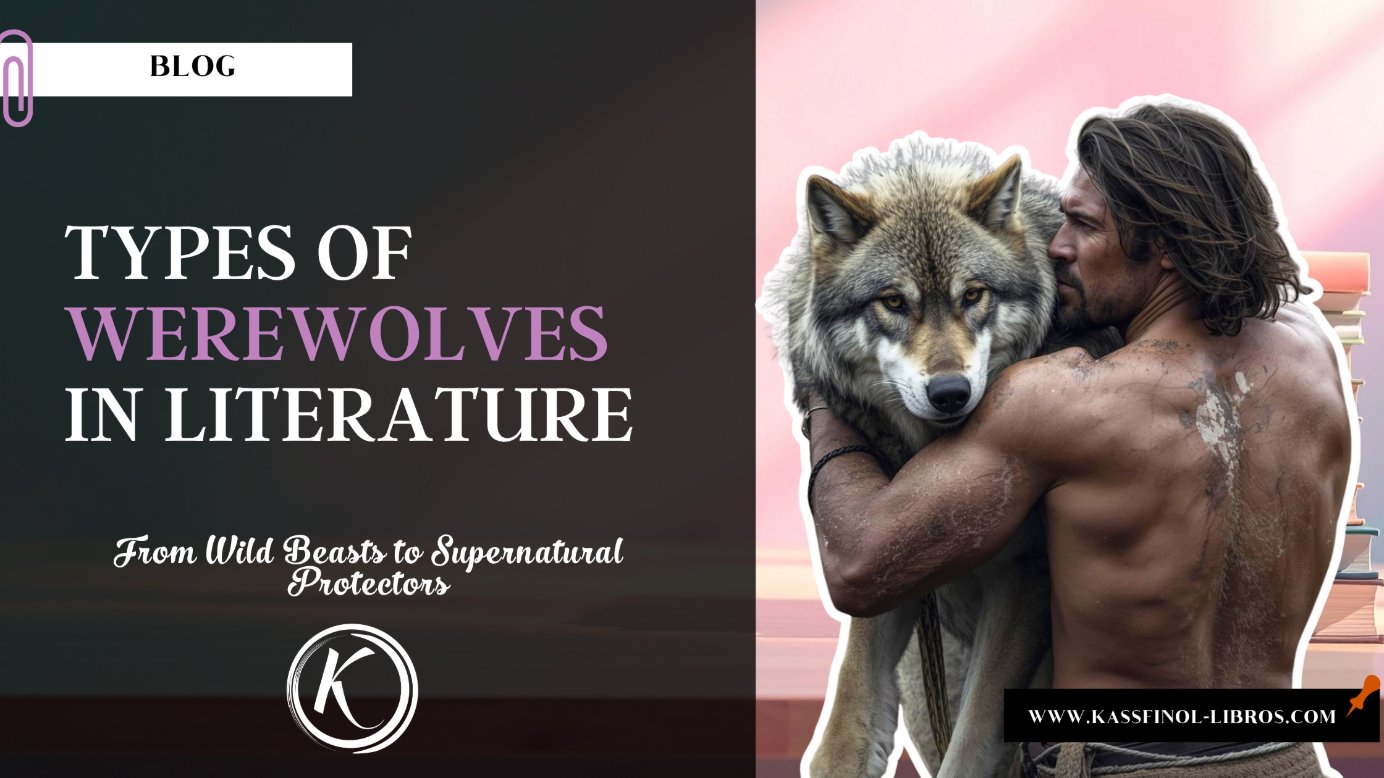
Ahhh, readers, for now this is writer Stefania Gil’s last entry for this blog; today she’ll talk to you about werewolves in paranormal romance literature. The research is great, so I hope that if you liked it, you’ll share it.
Just a month and a few days after the launch of Midnight Sun, many of us are seeing a new wave of paranormal beings in literature coming that will take us on great adventures; and lycanthropes, or werewolves in literature, will have their marked space because, where there is a vampire, there will also be a werewolf; so I did a little research that I’m going to share with you today.
Origins of Werewolves in Popular Folklore
The legend of the werewolf could have its origin in very remote times. It is a legendary creature in much of the world and probably, along with the vampire, the most universal of myths.
Let’s start by clarifying that, in folklore and mythology, the werewolf or lycanthrope is a person who transforms into a wolf and, depending on the origin of their lycanthropy — a curse or another cause — they may transform voluntarily or involuntarily.
What is known about them in popular culture is:
That they are normal, ordinary men most of the time. Some stories make them a bit hairier than usual and with more developed senses than an ordinary human.
Above all smell and hearing. They also enjoy perfect health and physical shape.
It is believed that on full moon nights is when this “normal” man transforms into a lycanthrope:
Since some versions claim that it is the moonlight that controls their transformations, which have evolved over the years; going from transforming into a hairy humanoid with claws and fangs to a real wild wolf but larger than the one you might find in a beautiful forest; of course, the legend assures that whatever form they transform into, their end is the same: to attack and kill because they seek human flesh and blood.
Many legends speak only of flesh; others go straight to extracting the heart to feed properly.
There are many theories about their existence:
Among them, we will find the ones that make the most sense within the world of paranormal beings: the use of hallucinogenic plants in ancient times; plants that made you fly and see things that made no sense: fearsome beasts, infernal monsters and other creatures you had to save yourself from by killing.
Or dying, because many times, depending on what people had in their heads, hallucination could make a person believe they had become a murderous monster with great power over others.
There is another theory associated with these hallucinogens that could explain the episodes of werewolves in Europe during the 18th and 19th centuries.
It is directly related to ergot, a fungus that grows where rye is cultivated in wet seasons, after very cold winters.
Ergot poisoning normally affects entire villages, or at least the poor areas of villages, causing hallucinations, mass hysteria and paranoia, as well as convulsions and, on some occasions, death (LSD is derived from ergot).
Of course, none of this is told to us in werewolf stories in literature, but some of the hallucinogen part with rye could be real because, if we think about it, this is the same thing that could have happened to the girls who died in 1692 in Salem, Massachusetts, accused of being witches, turning the story of the Salem Witches into the most remembered and best-known in the world.
We can leave this for another entry because with the Salem witches we could write a complete undergraduate thesis if we wanted.
Anyway!
Whatever the case, and even though I am a faithful defender of the paranormal — praying to run into a vampire, a fairy or an angel one day; I hate Lycanthropes, though not all of them, I admit; but for the most part, I can’t stand them as I was saying, whatever the case regarding the use of Belladonna or rye-contaminating fungi in ancient times; and whether the person was victim or victimizer, they were in great danger as soon as they started imagining things that didn’t exist.
There are other factors that science has proven and from which the werewolf legend could derive.
They are conditions such as:
— Rabies.
— Hypertrichosis, which is excessive hair growth on the body.
— Porphyria, an enzymatic disorder that creates hallucinations and paranoia.
— Clinical lycanthropy, in which a person believes they are transforming into an animal, although not always into a wolf.
However, there are beliefs based on documented events such as that of the Beast of Gévaudan, a creature that terrorized the general area of the province of Gévaudan, in the current Department of Lozère, in the Margeride Mountains in southern France, between 1764 and 1767.
The beast was described as a giant wolf that attacked livestock and human beings without distinction. According to the accounts, it was killed by Jean Chastel with a silver bullet, and from there comes the myth that werewolves can only be killed that way.
Werewolves in Literature
Returning to the legends, the first recognized werewolf in fiction was Lycaon, king of Arcadia, Greece; a wise king and a very religious person who brought his people out of the savage conditions in which they originally lived. Of course, all this showing himself to be good had a macabre purpose that allowed him to continue sacrificing human beings in honor of Zeus.
Zeus wanted to verify the rumors and disguised himself as a beggar to pay Lycaon a visit. Fortunately, Lycaon found out in time that Zeus was the beggar, so he invited him to take part in a sumptuous banquet.
Things would have gone well if Lycaon hadn’t played a horrible joke on Zeus, ordering that he be served the flesh of a child.
The King of Olympus realized it and, filled with rage, condemned Lycaon, and all his descendants, to become wolves.
This story could be the first record in texts that talk about the legend of that hairy being.
Herodotus mentions a people he places northwest of Scythia, who transformed into wolves annually for a few days.
Virgil was also familiar with the transformation of human beings into wolves.
With the arrival of the Middle Ages:
Tales of men who transformed into wolves were common and people had so much faith in them that they didn’t even dare go out at night into the forest.
With good reason, because in those times, real wolves were common and it wasn’t rare for them to attack people.
And since then various werewolves have been appearing in literature; thus, in 1828 Richard Thomson anonymously published The Wehr-Wolf: A Legend of the Limousin (in the anthology The Best Werewolf). The author places us in 1520, in France, and tells us the story of a werewolf’s revenge, helped by his daughter, aware that she will suffer the same fate as her father.
Also to be found in the previous anthology is a story titled The Man-Wolf by Leitch Ritchie.
Written by Frederick Marryat: The White Wolf of the Mountains; two standalone chapters that are part of the book The Phantom Ship, published in 1839.
The Wolf Leader by Alexander Dumas is a disturbing and moralistic novel in which, delving into the depths of the soul, all the evil that the human being can contain is shown.
The French writers Erckmann-Chatrian and Alexandre Chatrian, who would work together throughout their literary career, published in 1859, Hugo the Wolf, and an interesting novelty in the genre’s stories: the Black Death, in the form of a woman, as a character.
The Grey Wolf by George MacDonald, published in 1871, tells the story of a young woman who, living with her mother in a cabin, transforms into a great grey wolf ready to tear apart and devour anyone she finds in her path.
Rudyard Kipling, who wrote The Mark of the Beast in 1890.
In 1908 we find The Camp of the Dog, by Algernon Blackwood; the author introduces an expanded and projected state of consciousness, which can become visible to others, to convert his werewolf through psychic, involuntary and unconscious transformation.
The Wolf’s Bride, by Aino Kallas, was published in 1928 and tells the adventures of Aalo, wife of the forest ranger Priidik, transformed into a wolf by Satan, who fled deep into the forest and lived with the wild beasts and with the Diabolus sylvarum.
Guy Endore wrote The Werewolf of Paris, in 1933. Bertrand, who since childhood shows strange behavior at night, discovers that his dreams, in which he becomes a werewolf, are part of reality.
In The Wolfen (1978), by Whitley Strieber, werewolves are portrayed as predators of humanity. The author returned with The Wild, in 1991, presenting werewolves as a means to return intelligence and the human spirit to nature.
What Are the Characteristics of Werewolves in Literature?
As I mentioned before, the myth of werewolves in literature seems to originate in Europe and is linked, the vast majority of times, to superstitions, curses, black magic and pacts with the devil.
As a general rule, it is men who are turned into wolves; now it is more common to see female lycanthropes, but it is not the usual thing.
There are other characteristics such as:
— Covered with a wolf’s skin.
— Having their senses alert even in human form.
— They are impulsive and territorial.
— They are very connected to nature.
— They may have the ability to control their transformations.
— Once transformed, they are mortally aggressive and represent an enormous danger even to their loved ones because it seems the rational part is blocked by animal instinct, nullifying all their thoughts and leaving them at the mercy of the needs the wild animal has at that moment.
— As humans, they have a strength that defies all logic.
— The bite is lethal and can turn another human into a lycanthrope.
— Vampires fear their bites because the myth has arisen that the lycanthrope’s bite on the body of the living dead can have a venom reaction that consumes the vampire and drives it to absolute madness and even real death.
— Once turned into wolves, whether by birth, a curse or a bite, their transformations can be triggered by the full moon or at the person’s will. In any case, it is always described as torment for the human because it is assumed that every bone in the body breaks and then reassembles into another form: a humanoid with claws, hair and fangs, or a real wolf but larger.
— They have great healing capacity.
— They die if wounded with a silver object. Tradition speaks of silver bullets straight to the heart.
An Evolution of Werewolves in Paranormal Romance Literature
This class of ghostly and terrifying characters is common within the Gothic genre, where they were created to terrify their readers.
However, modern literature has adopted them to make them evolve by touching on romantic themes, where paranormals fall in love across species or with humans.
This evolution of werewolves in paranormal romance literature gives them the desire — or the longing — to live a normal life despite the curse they carry or their genes, because many of these characters inherit the power of lycanthropy from an ancestor and discover it during adolescence.
We no longer see them as beings with monstrous fangs covered in hair; now they are real wolves, sometimes of normal size, other times much larger, just like the wolf pack of Jacob Black, an important character in the Twilight Saga.
Of course, not everything will be rosy in the lives of these supernatural beings, because, in no species is everyone good; there will be their rotten apples determined to do a lot of harm, but there will always be a hero who redeems the actions of this character or perhaps a heroine who makes him fall into the nets of love, turning him into a tame little animal.
Or simply a being who carries evil, but chooses not to harm because they know it’s not right.
Those are the kind of paranormal beings that make us fall in love and sigh like teenagers.
And despite still having a very secondary role, as if they were a perpetual threat or mortal enemies of vampires, who are the stars of the story, new novels keep emerging where the werewolf takes full protagonism.
J. K. Rowling includes this character in her Harry Potter books. A werewolf named Remus Lupin, remember him? Remus takes a potion at full moon to achieve his wolf form, but with human consciousness.
There is also another lycanthrope named Fenrir Greyback and, unlike Lupin, he loves being a werewolf and biting people even when there is no full moon.
The king of horror in literature, Stephen King, also gives us a werewolf named Lobo who helps young Jack Sawyer in his adventure to locate an ancient item of power.
I’ve already mentioned her in other posts, but she’s one of my favorite authors and her world has many paranormal beings:
Cassandra Clare in Shadowhunters gives us several people close to Clary, the protagonist, who are werewolves.
Who could forget Tyler Lockwood in The Vampire Diaries? And Alcide Herveaux in The Sookie Stackhouse Adventures (True Blood)?
Werewolves in today’s literature are stronger, they have new powers that, sometimes, they can keep even in their human form, they use telepathy to communicate with each other when they’re animals or between them and a human.
They can transform at will.
We hardly see werewolves who can’t control their own transformation anymore; and the full moon doesn’t affect them as much.
Now they’re also very handsome, although on many occasions they’re made to look like sloppy beings, without aspirations, dirty. As if being a werewolf were synonymous with being a failure, which seems a bit unfair to me.
In my opinion, the peak of these characters’ evolution was the unexpected twist in the plot of The Originals, when we’re told that Klaus, the meanest and most capricious vampire in the series, is a hybrid: Wolf + Vampire and the only one who holds the cure for a wolf’s bite in a vampire’s body.
I loved that combination. What about you?
Let me recommend some werewolf novels in paranormal romance literature, besides the ones I mentioned above, which are the best known:
— Dark Lycan by Christine Feehan
— The Wolf Gift Chronicles by Anne Rice
— Vanir Saga by Lena Valenti
— Dark Guardian series by Rachel Hawthorne
— Other book recommendations about werewolves
Now it’s your turn to tell us in the comments:
What do you think of lycanthropes, and which werewolves in paranormal romance literature are your favorites?
I’m Kassfinol, a Venezuelan paranormal romance author published on Amazon KDP since 2012. My collaborator Stefanía admits she hates werewolves, and I understand, but I write them. In my Invocation Series the werewolves have character, they have a real duality between their animal nature and their human side, and they don’t exist just to be threatening: they have reasons for being what they are and that makes them much more interesting. If you want to meet them, start with the Invocation Series. And if you’d rather try before commiting to a complete saga, I have more than 40 free short stories available on this website.